
Views: 0 Author: Site Editor Publish Time: 2026-03-04 Origin: Site


FR4 is the standard rigid laminate used as the backbone of most printed circuit boards and many electrical insulating parts. It’s an epoxy resin system reinforced with woven glass fabric that’s formulated to resist ignition. Think of it as a cured, fiberglass-reinforced sheet that combines mechanical stiffness, electrical insulation and a baseline level of flame retardancy — all at a competitive cost.
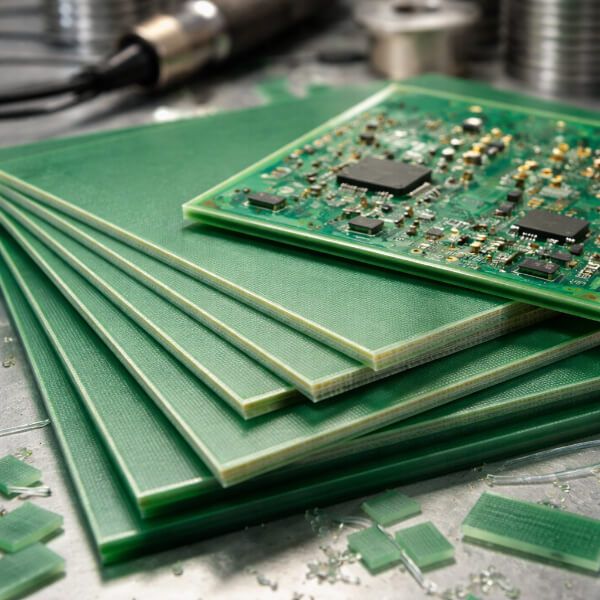
Reinforcement: woven E-glass cloth in various weaves and weights.
Matrix: thermosetting epoxy resin (formulations differ to tune temperature tolerance and flow).
Formats: unclad sheets and copper-clad laminates (single/double/multi-layer stacks use prepregs between sheets).
Safety tag: typically produced to meet common flame-retardant ratings required for electronics.
When designing circuits or insulating components, verify the following electrical numbers for the specific grade you plan to use:
Relative permittivity (Dk): usually in the ~3.8–4.8 range at low MHz frequencies — but it shifts with frequency and fabric type. Use the Dk value measured at the frequency most relevant to your product.
Loss tangent (Df): commonly around 0.01–0.03 at 1 MHz; microwave work needs specialist substrates with much lower loss.
Dielectric strength / breakdown: values vary by sheet thickness and test method; manufacturers report breakdown in kV under defined test conditions.
Practical rule: never assume a generic “FR4” value for controlled-impedance or high-frequency traces — pick the grade with Dk/Df characterized at your working frequency.
FR4 grades differ mostly by their glass transition and thermal robustness:
Standard Tg: typically about 120 °C or higher (suitable for many conventional soldering processes).
High-Tg grades: often specified in the 150–180 °C window for repeated lead-free reflow cycles or higher reliability needs.
Thermal conductivity: low — roughly 0.3–0.6 W/m·K — so heat dissipation must be engineered separately.
CTE: in-plane expansion is modest; through-thickness expansion is larger and is a key factor for via plating and lamination reliability.
If your assembly will see high reflow temperatures or extended thermal cycling, select a high-Tg material and ask for delamination/ Td performance data.
Density: in the ballpark of 1.8–2.0 g/cm³.
Stiffness: FR4 is rigid — suitable for rigid PCBs, structural insulators and spacers. Exact modulus depends on fabric weave and resin loading.
Moisture: FR4 absorbs some moisture; prolonged exposure to humid, hot environments can alter electrical and mechanical behavior. Use low-moisture variants if that’s critical.
For machined parts (cutters, CNC), standard FR4 machines like other laminates but produce fine dust — extraction and tooling strategies matter.
Choose according to process and performance needs:
Standard FR4: general electronics, low cost, good all-rounder.
High-Tg FR4: for lead-free assembly, automotive, or boards subject to sustained heat.
Low-loss / tuned FR4: improved Dk/Df control for higher-frequency circuits but still not a substitute for dedicated RF substrates.
Specialty laminates: tailored for improved moisture resistance, flame performance, or mechanical demands.
Match the laminate to assembly processes (lamination, reflow profile) and reliability requirements rather than defaulting to “whatever’s cheapest.”
Use drill bits and feeds optimized for glass-epoxy to reduce delamination and extend tool life.
For multilayer lamination, match resin flow (prepreg selection) to prevent voiding and ensure consistent dielectric thickness.
Specify high-Tg or validated time-to-delam characteristics for products that will undergo high-temperature assembly.
Validate plated-through-hole (PTH) reliability for tight via aspect ratios and high thermal cycling environments.
Small changes in stackup, resin content or cure schedule can noticeably affect thermal and mechanical outcomes — control them in procurement docs.
FR4 isn’t just for boards. Common secondary uses include:
Insulating washers, spacers and standoffs.
Busbar insulation and transformer supports where electrical insulation + flame resistance is required.
Prototyping fixtures and mechanical components requiring dimensional stability.
When replacing metal or plastic parts with FR4, consider mechanical loads and long-term moisture exposure.
G10: similar glass-epoxy family but historically not optimized for flame retardancy like modern FR4 grades.
Polyimide (PI): far better at sustained high temperatures; used where Tg and thermal stability matter.
RF laminates (e.g., PTFE-based, ceramic): offer much lower loss and tightly controlled Dk for microwave work — use when signal integrity at high GHz frequencies is critical.
Choose the material to fit electrical, thermal and regulatory needs — cost is important, but not the only factor.
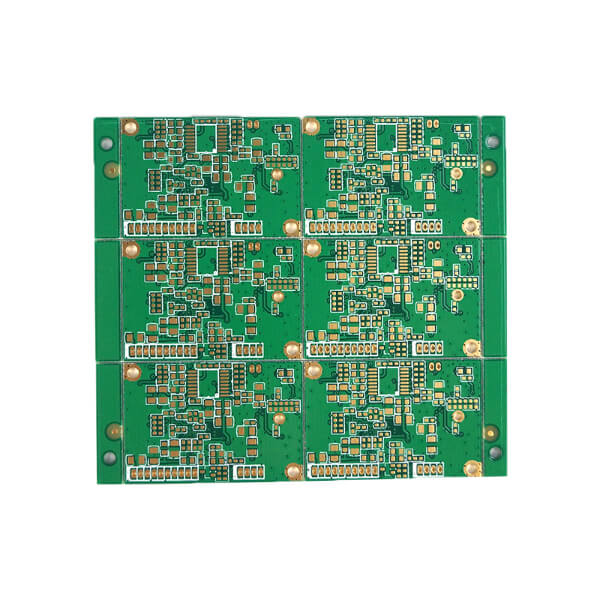
When ordering, specify these explicitly:
Manufacturer part number or IPC slash-sheet reference (do not write only “FR4”).
Required Tg (DSC), or “high-Tg” if needed.
Dk and Df with frequency of measurement.
Thickness and tolerance, copper weight if clad.
UL / flammability rating and any other regulatory requirement.
Time-to-delamination or Td if assemblies see >240 °C.
Any environmental requirements (low moisture, halogen-free, etc.).
A precise spec reduces surprises and helps QA acceptance on delivery.
Q: What does FR4 mean?
A: It denotes a family of flame-retardant epoxy laminates reinforced with woven glass cloth, commonly used for rigid PCBs and electrical insulation.
Q: When should I choose high-Tg FR4?
A: Pick high-Tg when assemblies will see lead-free reflow temperatures or repeated thermal cycling that could approach or exceed ~140 °C.
Q: Can I use FR4 for RF circuits?
A: For low-to-mid frequencies FR4 is fine, but for precise, low-loss RF/high-GHz work, use substrates engineered for RF performance.
Q: What key specs should be on my purchase order?
A: Include exact part number or IPC slash-sheet, Tg, Dk/Df at the application frequency, thickness & tolerances, copper weight, and required flammability rating.
Don’t treat “FR4” as a single material — it’s a product family. Specify the exact grade and the measurement conditions for dielectric and thermal data. When in doubt, ask suppliers for the IPC slash-sheet or the manufacturer datasheet and insist on test data measured at the frequencies and temperatures relevant to your product.


