
Views: 0 Author: Fenhar Publish Time: 2026-09-09 Origin: Site


Watch a CNC drill descend onto a printed circuit board panel and you will see it pass through three materials before the day is done. Above the panel sits a thin brown sheet — the entry board. Below it sits a thicker, darker sheet — the backup board. The laminate in the middle carries the circuits and gets all the attention. The two phenolic sheets get none, even though they are the only materials in the entire process chosen to be drilled on purpose. They exist to be sacrificed, and the quality of every hole in the panel depends on how well they do it.
Get the stack wrong and the symptoms are familiar to every fab: drills that wander off pad, copper burrs on entry and exit faces, ragged hole walls that fight the plating line, carbide bits that dull after a shift instead of a week. Get it right and drilling becomes boring — which is the point. This article walks through what phenolic entry and backup boards actually do, why paper-based phenolic is the material of choice, and how to select, use, and store both consumables so they do their jobs quietly.
A drilled hole has two edges that matter — where the bit enters the copper and where it breaks out. Burr physics at the two ends are different, so the two sacrificial layers do different jobs:
| Entry Board (top, thin) | Backup Board (bottom, thick) | |
| Owns | The top edge of every hole | The bottom edge of every hole |
| Primary jobs | Centers the rotating bit before it touches copper; stops tip walk on hard foil; controls entry-side burr; shields the panel face from scratches and nail-heading | Supports the laminate through breakthrough; prevents exit teardrop burrs and fiber pull-out; protects the drill tip — and the machine table — from contact; helps chip escape at the exit |
| Typical thickness | 0.3–1.5 mm, matched to drill diameter | 1.5–3.0 mm, the working horse of the stack |
| Failure signature | Drill wander, off-pad holes, entry burrs, scuffed panel faces | Exit burrs, breakout, torn hole exits, chipped backup surface |
| Replacement rhythm | Often renewed every stack — cheap insurance | Roughly every 1,000–3,000 hits, or by symptom |
Read down the two middle rows and the division of labor is clean: the entry board is a guidance problem; the backup board is a support problem. The entry's hardest moment is the first fraction of a second, when a carbide bit spinning at over a hundred thousand RPM touches hard copper foil with nowhere to hide — a fraction of a millimeter of deflection there becomes an off-pad hole ten layers later. The backup's hardest moment is the last, when the bit breaks through the bottom foil into unsupported space and will tear a teardrop-shaped burr out of the copper unless something is holding the laminate together from behind.
The case for disciplined consumable selection is easiest to make through its failure modes — each one traceable to a specific missing function:
Drill wander and tip walk. Carbide is hard but brittle, and a rotating bit meeting bare copper can skid before it cuts. The entry board's surface gives the tip a phenolic bite zone — enough resistance to center the bit before it reaches the foil. Without it, hole-to-pad registration suffers first on the smallest holes, where the ratio of deflection to diameter is worst.
Entry burrs and nail-heading. Pushing foil and glass into the hole mouth deforms the top copper into a raised collar and can flare inner-layer copper into the classic nail-head. A hard, smooth entry surface spreads this deformation and keeps the top edge clean.
Exit teardrop burrs. When the drill breaks through into a void, the bottom foil stretches and tears outward — the teardrop. A backed laminate breaks through against a solid phenolic face and shears cleanly instead.
Fiber pull-out and breakout. The backup supports the resin/glass matrix so fibers are cut, not ripped. This matters most on fragile substrates — PTFE, flex, aramid — where the panel itself cannot tolerate rough treatment.
Bit breakage. A micro-drill that exits into empty air snaps; one that bottoms out on the table is destroyed. The backup is the last line of defense for a tool that may cost more than the sheet protecting it.
Resin smear. Drilling friction melts epoxy onto hole walls; the wiping action of the bit passing into a clean, dry, consistent sacrificial material helps limit smear depth — one reason damp or degraded consumables show up first as desmear problems downstream.
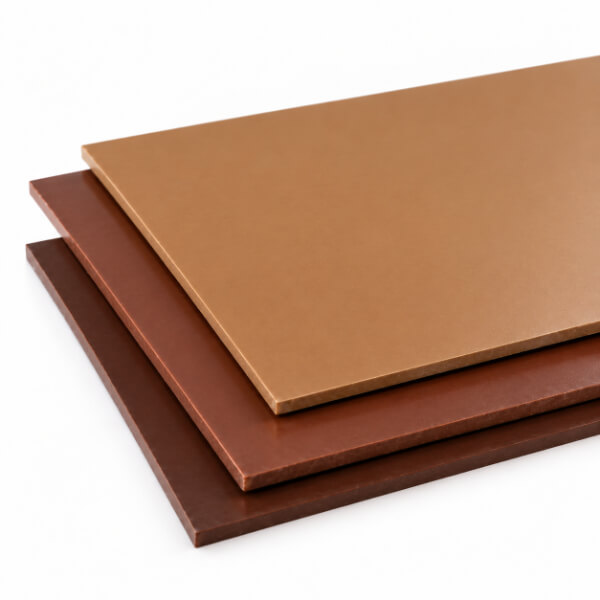
Entry and backup consumables have been made from paper-based phenolic laminate for decades, and the choice is not inertia — it is that the material sits precisely where the physics wants it. Phenolic paper board is layers of wood-pulp paper impregnated with modified phenolic resin and pressed hot into a dense, uniform sheet. Paper gives the laminate a fine, even fiber structure; phenolic gives it hardness, heat resistance, and a naturally low-abrasion character that no mineral-filled alternative matches.
The property that makes or breaks a drilling consumable is a balance, not a maximum: hard enough to center a spinning bit and support clean breakthrough, soft enough — and non-abrasive enough — not to grind away carbide. This is the hardness paradox of the drilling stack, and phenolic paper threads it better than anything else at the price point. A glass-filled laminate would center beautifully and destroy tool life; a soft plastic would spare the drill and let it wander. Modified phenolic paper — typically Shore D 88–120, density around 1.3–1.45 g/cm³ — lands in the window where both jobs get done.
| Property | Typical Range (Electrical-Grade Phenolic Paper) | Why It Matters in the Stack |
| Density | 1,300–1,450 kg/m³ | Uniform density = uniform bite on the bit = consistent hole-to-hole behavior across the panel |
| Surface hardness | Shore D ~88–120 | The hardness-paradox window: centers the bit, controls burrs, spares carbide |
| Thickness tolerance | ±0.10 mm on 0.8–1.5 mm stock | Z-axis depth consistency — critical for controlled-depth drilling and blind vias |
| Flatness / warpage | Under ~0.6 mm/m across the diagonal | Full face-to-face contact with the panel under vacuum; gaps become burrs |
| Abrasive fillers | None (specified filler-free) | Hidden sandpaper in cheap stock is a drill-life killer — the specifier never sees it |
| Flammability | UL 94 HB class | Ancillary for a drilling consumable; relevant near hot spindles and routing debris |
Two specification habits separate good consumable buyers from frustrated ones. First, specify the absence of abrasive fillers in writing — filler-loaded economy stock looks identical at the loading dock and announces itself only as a sudden drop in tool life. Second, treat thickness tolerance and flatness as first-class electrical-process parameters, not paper mill trivia: every micron of stack-height inconsistency lands directly in the Z-axis of a blind via, and every warp gap between panel and backup is an invitation for the bottom foil to tear.
Consumable selection follows the drill, not the datasheet. The variables that move the decision are hole diameter, stack height, substrate fragility, and — above all — total process cost:
| Drilling Scenario | Entry Choice | Backup Choice | Rationale |
| Standard mechanical holes, ≥0.3 mm | Phenolic paper entry, 0.3–0.8 mm | Phenolic paper backup, 1.5–2.0 mm | The economical default; phenolic's balance is fully adequate at these diameters |
| Microvias / HDI, <0.25–0.3 mm | Aluminum foil or aluminum-composite entry | Fine-surface phenolic backup | Aluminum pulls heat from a tiny carbide bit and gives the most consistent centering surface; drill wear from aluminum is acceptable at these tool budgets |
| Fragile substrates (PTFE, flex, aramid) | Fine-surface phenolic paper entry | Fine-surface phenolic backup, possibly thinner stacks | Non-abrasive, gentle support matters more than throughput; both sheets act as strain cushions |
| High stack count (throughput drilling) | Hard-surface phenolic entry | Thicker phenolic backup, 2.0–3.0 mm | Deeper stacks amplify deflection and heat; the backup does more work per hit |
| Routing / profiling | Optional thin entry | Phenolic backup board as routing underlay | Same exit-burr and breakout logic applies to the router bit's exit side |
The economics deserve one honest paragraph, because the consumable market presses in the wrong direction. Entry and backup boards are priced per sheet, so the cheapest sheet wins the purchase order — but the real cost of a drilling stack is sheet price + drill life consumed + burr rework labor + scrap risk on a panel worth a hundred times the sheet. A filler-loaded backup that saves a few cents per panel while shaving 20% off micro-drill life has bought nothing. Fab engineers who track cost per finished hole, not cost per sheet, consistently land on cleaner, harder-surfaced, filler-free phenolic — because the stack is the cheapest insurance in the process.
Most consumable problems in the drill room are storage and handling problems wearing a disguise:
Moisture is the silent one. Phenolic paper laminate is mildly hygroscopic. A damp backup smears, a damp entry raises drilling torque, and a stack assembled from sheets at different humidity levels behaves unpredictably hit to hit. Store consumables dry and sealed, and let them acclimate in the drill room before use — condition the stack like you would condition the laminate.
Flatness is a consumable property that expires. A bowed backup that once drilled clean now leaves a gap under the panel; gaps become burrs. Store panels flat, supported across the full area, never on edge, never under point loads.
Respect the hit count, but read the surface. The 1,000–3,000 hit figures are planning numbers, not guarantees. Rising burr heights or visible chewing on the backup face outrank any counter — and rotating the backup to a fresh zone stretches yield when drill patterns allow it.
Pair the renewal of entry and backup. Replacing one and not the other means one end of every hole is being managed to a different standard. The two sheets are a set; retire them as a set.
Consider a 0.25 mm via job on standard FR-4, six panels per stack, high-volume production. Working backward from the failure modes: the exit edge is the highest-risk feature, so the backup is a 2.0 mm filler-free phenolic paper board, Shore D near the top of the window, flatness under 0.6 mm/m, renewed on symptom or count; the entry edge needs centering more than cooling at 0.25 mm, so the entry is a 0.5 mm hard-surface phenolic paper sheet renewed with every stack; the stack is conditioned to drill-room humidity before it hits the vacuum table; and tool-life data is logged per entry/backup batch, because a change in drill life is often the first measurable signal that a consumable lot has drifted. None of those decisions came from the consumable datasheet's headline numbers — they came from the failure modes the stack exists to prevent.
They manage the two ends of the same hole. The entry board, a thin phenolic paper sheet on top of the panel, guides the drill into the copper — it centers the rotating bit before it touches the laminate, stops the tip from walking on hard copper foil, and controls the top-side burr. The backup board, a thicker phenolic sheet beneath the panel, owns the exit: it supports the laminate so the copper at the bottom does not tear into a teardrop burr when the drill breaks through, and it stops the bit from hitting the machine table. Entry failures show up as wander and rough top edges; backup failures show up as exit burrs and fiber pull-out.
As hole diameters shrink below roughly 0.25–0.3 mm, aluminum entry (thin foil or aluminum-composite sheets) starts to win, because it conducts heat away from the tiny carbide bit far better than phenolic paper and gives an extremely consistent centering surface. For standard mechanical drilling above that range, phenolic paper entry is the economical default — it is non-abrasive, cheap, clean, and gentle on tool life. Many high-mix shops run both: aluminum foil entry for microvia work, phenolic paper entry for everything else.
In production practice a backup board survives on the order of 1,000 to 3,000 drill hits before its surface is too chewed up to support clean hole exits — the exact count depends on hole diameter, stack height, and hit density. The practical rule is to replace it by symptom, not just by count: rising exit-burr heights, ragged hole exits, or visible surface chewing on the backup are the signals. Entry material works the opposite way — it is cheap enough that many shops renew it with every stack rather than tracking hit counts on it.
Check two things in the consumables before blaming the drill supplier. First, abrasive fillers: some low-grade entry and backup materials contain hard mineral fillers that act like sandpaper on carbide — quality phenolic paper entry material is specified without abrasive additives. Second, moisture: phenolic paper laminate is hygroscopic, and a damp stack smears resin into hole walls, raises drilling torque, and shortens tool life. Store panels and consumables dry, and condition the stack in the production area before drilling so entry, panel, and backup are at the same humidity.
Entry and backup boards are the least glamorous purchases in a PCB fab and among the most consequential. The entry board owns the top edge of every hole; the backup owns the bottom edge; and between them they decide drill life, burr height, hole-wall quality, and whether a registered hole lands on its pad. Phenolic paper earns its decades in the stack by threading the hardness paradox — hard enough to center and support, non-abrasive enough to spare the carbide — at a price that survives high-volume economics. Specify it the way the drill room experiences it: by failure modes prevented, not by price per sheet.


