
Views: 0 Author: Fenhar Publish Time: 2026-05-21 Origin: Site


When an electric motor fails at 15 000 RPM or a spindle bearing seizes after a cold start, the root cause is often not the winding or the shaft – but two small, composite parts that most engineers take for granted: the commutator reinforcing ring and the bearing cage.
Both are made from thermoset composites, but the similarity ends there. One needs to hold copper segments against centrifugal force without conducting electricity. The other needs to space rolling elements while surviving marginal lubrication. Getting the right grade – G10, G11, FR‑4 for rings, or PFCC, PFCP for cages – makes all the difference.
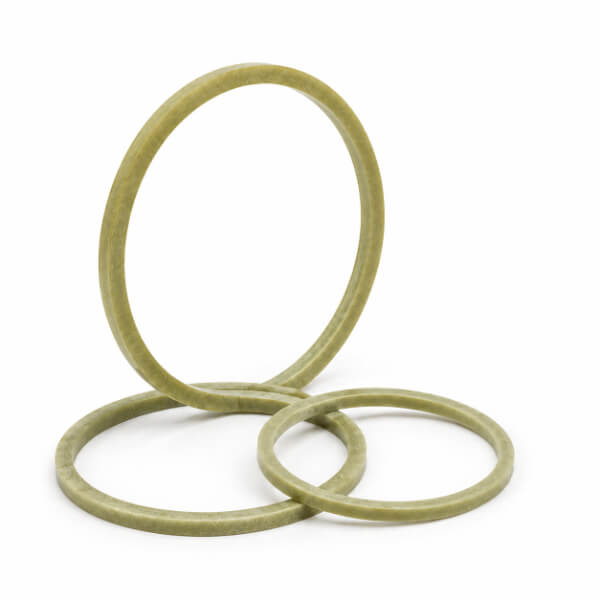
A commutator ring sits directly around the segmented copper cylinder of a brushed DC motor. Its job is purely mechanical and electrical: resist hoop stress from high‑speed rotation, and insulate each segment from the next and from the shaft.
Why epoxy glass? Because polyester or plain phenolic rings crack under thermal cycling, and metal rings short out. Woven glass fabric embedded in an epoxy matrix gives the best combination of strength, insulation, and fatigue resistance.
Standard grades in industry
G10 – General purpose. Continuous operating temperature around 130 °C. Excellent dielectric strength (typically >20 kV/mm) and low water absorption. Used in starter motors, power tools, and small industrial DC motors where temperatures stay moderate.
G11 – High‑temperature version. Continuous use up to 160 °C, with short spikes to 210 °C. Better dimensional stability under heat due to a modified epoxy resin. Recommended for lift truck motors, heavy‑duty starters, and any commutator that sees frequent overloads.
FR‑4 – Flame‑retardant grade, self‑extinguishing (UL 94 V‑0). Electrical and mechanical properties are similar to G10, but the resin includes brominated or phosphorus compounds. Mandatory for motors used in appliances, railway equipment, and any application requiring fire safety certification.
All three grades are typically produced as woven glass fabric laminates, then machined into rings. For extreme burst strength, some manufacturers offer filament‑wound versions using unidirectional glass roving (same resin systems, but fiber orientation purely in the hoop direction).
What to look for in a ring
Tensile strength >200 MPa (moulded) or >600 MPa (filament wound)
Dielectric strength >18 kV/mm
Water absorption <0.2 % (prevents swelling and loss of fit)
Machined tolerances within ±0.02 mm on inner/outer diameter
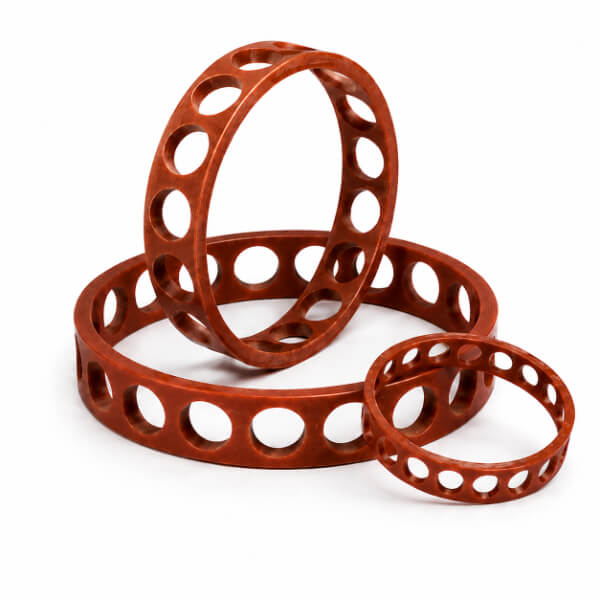
Rolling bearings need a cage (retainer) to keep balls or rollers evenly spaced. At low speeds, stamped steel or machined brass works fine. But above 10 000 RPM, metal cages become a liability: they are heavy, they gall against the rolling elements, and they offer no oil storage.
Phenolic resin cages solve all three problems. They are made from laminated cotton or glass fabric impregnated with phenolic resin, then cured and machined. The material is intentionally porous – those micro‑voids act as a reservoir for lubricant.
Common phenolic cage grades
PFCC (Phenolic, Fine Cotton fabric, standard porosity). The workhorse of high‑speed ball bearings. Cotton reinforcement gives excellent machinability and a smooth pocket surface. Standard porosity provides balanced oil retention without becoming too weak. Temperature limit: 117 °C (250 °F). Used in machine tool spindles, dental handpieces, and precision instrument bearings.
PFCP (Phenolic, Fine Cotton, enhanced porosity). Higher void volume for improved oil wicking. Ideal for oil‑mist or oil‑jet lubrication systems, or for applications where the bearing runs intermittently and needs to hold oil between starts. Slightly lower mechanical strength than PFCC, but significantly better self‑lubricating behavior during momentary oil starvation.
PFGC (Phenolic, Glass fabric) – available on request. Higher strength and higher temperature capability (up to ~150 °C), but lower porosity and reduced self‑lubrication. Used in heavier‑duty bearings where mechanical load dominates over extreme speed.
Why porosity matters
When a phenolic cage spins, centrifugal force pumps oil from the pores to the ball pockets. If the oil film breaks down – say, during a cold start or an overload – the phenolic transfers a thin dry transfer film to the steel balls. This prevents metal‑to‑metal contact and buys time until lubricant returns. Steel and brass cages cannot do this.
Dimensional precision
Pocket clearance is critical. Too much clearance causes ball skidding and cage wear. Too little causes binding and overheating. Good phenolic cages hold pocket clearance to ±0.05 mm or better, using CNC drilling or milling from laminated tubes.
| Material family | Typical grades | Primary function | Key advantage | Limitation |
| Epoxy glass (ring) | G10, G11, FR‑4 | Hoop strength + insulation | High dielectric strength, high tensile modulus | Not porous, no self‑lubrication |
| Phenolic cotton (cage) | PFCC, PFCP | Spacing + oil storage | Porous, self‑lubricating, lightweight | Lower temperature limit (117 °C) |
| Phenolic glass (cage) | PFGC | Higher load capacity | Stronger than cotton, higher temp | Lower porosity |
Do not swap them – epoxy glass rings lack the porosity needed for bearing cages, and phenolic cages lack the burst strength and dielectric integrity required for commutator rings.
G10 / FR‑4 epoxy rings – continuous 130 °C, short peaks to 150 °C.
G11 epoxy rings – continuous 160 °C, short peaks to 210 °C.
PFCC / PFCP phenolic cages – continuous 100 °C, max 117 °C. Exceeding that causes carbonization and crumbling.
PFGC phenolic cages – continuous ~130 °C, short peaks to 150 °C.
For motors running above 160 °C commutator temperature, G11 is the only choice. For bearings in hot environments (e.g., near a furnace), you must move to polyimide cages or switch to non‑caged designs – but that’s a different engineering trade‑off.
Moisture and chemicals
Epoxy glass (G10, G11, FR‑4) has very low water absorption (0.05–0.2 %) and resists oils, fuels, and mild acids. Phenolic cages absorb more moisture (typically 0.5–1.5 %) but are perfectly stable in oil and grease – just avoid high‑humidity storage before assembly.
G10 ring – Automotive starter motors, economy power tools, small DC pumps.
G11 ring – Industrial lift trucks, mining equipment, railway traction motors.
FR‑4 ring – Washing machine motors, HVAC blowers, any appliance requiring UL certification.
PFCC cage – CNC spindle bearings (12 000–30 000 RPM), dental turbines, aircraft instrument bearings.
PFCP cage – Vacuum pump bearings, oil‑mist lubricated spindles, gearbox needle bearings with intermittent oil supply.
PFGC cage – High‑load ball screws, electric vehicle transmission bearings where temperatures exceed 120 °C.
If you are an OEM or a repair shop, ask your composite supplier for:
For a commutator ring
Material: epoxy glass laminate, woven fabric
Grade: G10, G11, or FR‑4 (and whether flame rating is needed)
Dimensions: ID, OD, thickness with tolerance
Optional: filament‑wound instead of laminated (specify if burst pressure >500 MPa)
For a bearing cage
Material: phenolic cotton fabric laminate
Grade: PFCC (standard) or PFCP (high porosity)
Pocket count, ball diameter, and pocket clearance (reference bearing number)
Temperature requirement – if above 117 °C, request PFGC or discuss alternative materials
Most reputable composite manufacturers – including but not limited to Fenhar, ATG, or Norplex – can supply these grades under their own quality systems. The key is to request material certificates that confirm the specific grade (G10, G11, FR‑4, PFCC, PFCP) and relevant test data (dielectric strength, water absorption, tensile strength, porosity level).
Epoxy glass and phenolic composites are not interchangeable. Use G10, G11 or FR‑4 epoxy glass for commutator reinforcing rings when you need high dielectric strength and thermal stability. Use PFCC or PFCP phenolic cotton for bearing cages when you need low weight, self‑lubrication, and high‑speed capability. Specify the grade, not just the material family, and your rotating machinery will run cooler, faster, and longer.


