
Views: 0 Author: Fenhar Publish Time: 2026-11-06 Origin: Site


A pickleball paddle is a sandwich: two thin E-glass fiberglass face sheets over a lightweight honeycomb core. The face sheet most builders ask for is 0.4 mm thick, because that thickness keeps basis weight down while the glass still carries the hit. This reference lays out the material numbers, the core choices, how a matte / frosted / glossy finish maps to surface roughness, and the standards a buyer should put on the purchase order. The point is to specify the part by property and method, not by a photo.
Pick the paddle up and you are holding a bonded panel, not a solid block. Two fiberglass skins sit on the outside. A honeycomb core sits between them. The edge guard wraps the rim, and the handle adds mass below the throat. Everything a ball feels at impact comes from the thin outer skins and the stiffness of the core behind them.
That structure is why a 0.4 mm sheet matters. The skin does not need to be thick to do its job; it needs to be light, flat and tough, and the core does the work of keeping the panel from folding. Specifying the skin alone — without the core, the finish and the test method — is how a paddle blank order goes wrong.
E-glass (electrical-grade) is the reinforcement almost every paddle skin uses. It is a borosilicate glass drawn into filaments, woven into a fabric, and bonded in a thermoset resin.
The "0.4 mm" is the finished laminate thickness, skin plus resin, after cure. Build the number up from the fiber and you see why the grade behaves as it does.
| Property | Method | E-glass filament | 0.4 mm FG face sheet |
| Density | ASTM D792 / ISO 1183 | 2.54 g/cm³ | 1.70–1.90 g/cm³ |
| Filament tensile strength | ASTM D578 | 3,100–3,800 MPa | — |
| Filament tensile modulus | ASTM D578 | 72–76 GPa | — |
| Composite tensile strength | ASTM D638 / ISO 527 | — | 200–300 MPa |
| Composite tensile modulus | ASTM D638 / ISO 527 | — | 14–18 GPa |
| Flexural strength | ASTM D790 / ISO 178 | — | 300–450 MPa |
| Flexural modulus | ASTM D790 / ISO 178 | — | 15–20 GPa |
| Notched Izod impact | ASTM D256 / ISO 180 | — | 200–400 J/m |
| Basis weight (sheet) | ASTM D3776 / ISO 536 | — | 600–800 g/m² |
| Glass content by mass | ISO 1172 / ASTM D2584 | — | 50–60 % |
| Water absorption, 24 h | ASTM D570 / ISO 62 | — | ≤0.20 % |
| Heat deflection / Tg band | ASTM D3418 / IPC-TM-650 | — | 120–150 °C |
| Flammability (FR grade) | UL 94 | — | V-0 achievable |
The row that drives the "light paddle" claim is the basis weight. A 0.4 mm sheet at 1.8 g/cm³ works out near 720 g/m², and the glass alone inside it is roughly half that. Halve the thickness to 0.2 mm and you halve the skin mass; double it to 0.8 mm and the paddle starts to feel dead.
So 0.4 mm is a working compromise, not a random pick.
The core is what stops the two skins from simply caving toward each other. Spread a thin skin over a rigid core and the panel gets stiff out of proportion to its weight.
Three core materials show up in paddle blanks. They do not behave the same.
| Core | Typical density | Cell size | Out-of-plane shear | Cost | Note |
| Polypropylene (PP) honeycomb | 80–200 kg/m³ | 6–12 mm | Moderate | Low | Most common in mass-market blanks; easy to bond |
| Aramid (Nomex) honeycomb | 30–120 kg/m³ | 3–6 mm | High | High | Best specific stiffness; temperature stable |
| Aluminium honeycomb | 30–120 kg/m³ | 3–8 mm | High | Medium | Conductive; needs isolation from electronics |
Read the density column and the whole design logic appears. A 10 mm core at 100 kg/m³ adds about 1 kg per square metre of panel — barely more than the two skins. Take that same core away and replace it with solid resin and the panel triples in mass.
The "composite honeycomb board" name simply means skins bonded to one of these cores into a single blank.
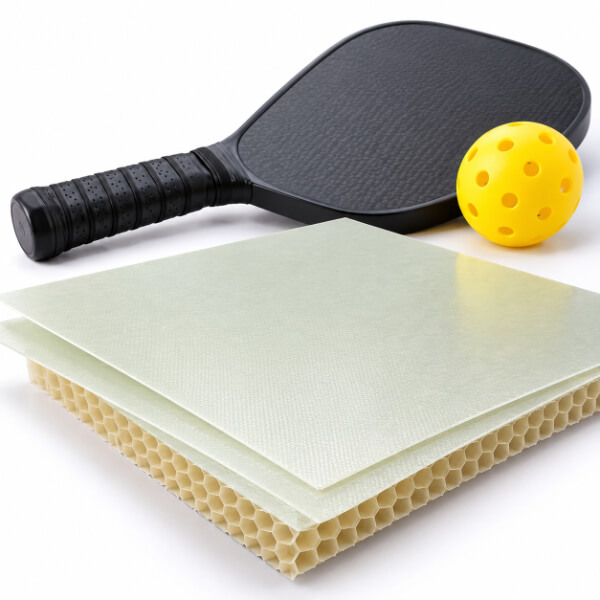
A paddle face is asked to do two opposite things at once. It must stay light so the hand moves fast at the kitchen line.
It must also not crack when a drive lands in the sweet spot or the rim hits the court.
Toughness here means flexural strength held over the panel, plus impact resistance that absorbs a hit instead of propagating a crack. The glass skin supplies both.
A thick solid plate would also be tough, but it would be heavy and it would damp the ball. The 0.4 mm skin over honeycomb gets the toughness at a fraction of the mass, which is the whole reason the sandwich format exists instead of a solid slab, and why paddle builders keep coming back to the same thin-skin recipe rather than reinventing the plate every season.
One more point buyers miss: a low basis weight skin that is flat and wrinkle-free bonds better. A heavy or uneven skin fights the press and leaves voids at the skin-core interface, and voids are where delamination starts.
The face finish is the only part of the material a ball ever touches, so it gets specified per side. The skins ship with a selectable single-side finish — matte, frosted (atomized) or glossy — and each finish sits in a different surface-roughness band.
Three finishes cover the field.
| Finish | Average roughness Ra | Rz (est.) | Measured by | 60° gloss | Gloss by | Ball feel |
| Glossy | 0.05–0.20 µm | 0.3–1.4 µm | ASTM D7127 / ISO 4287 | >80 | ASTM D523 / ISO 2813 | Low bite, slides |
| Frosted (atomized / satin) | 0.40–1.50 µm | 2–8 µm | ASTM D7127 / ISO 4287 | 20–60 | ASTM D523 / ISO 2813 | Balanced grip |
| Matte (brushed) | 1.50–4.00 µm | 8–28 µm | ASTM D7127 / ISO 4287 | <20 | ASTM D523 / ISO 2813 | Maximum bite |
Note on the rules. A paddle face is not free to be as rough as a maker likes, because roughness is how a paddle adds spin. The USA Pickleball Equipment Standards Manual (Revision 3.0, January 2025) caps surface roughness at an average no greater than 30 µm Rz and 40 µm Rt, read in six directions, with no single reading above 33 µm Rz or 44 µm Rt. The same manual fixes the combined length-plus-width at 24 in, the length at 17 in, and the paddle-ball coefficient of restitution at 0.43.
Put the limit next to the bands above and one fact stands out: a matte face at the top of its Ra band lands near the 30 µm Rz ceiling, while a glossy face sits far below it. So the finish that grabs the ball most is also the one a builder must measure most carefully. Treat the bands above as the material's native roughness, not as the legal maximum.
The skins photograph in two standard colours: an off-white / ivory and a mint-sage green. Both are the same glass-resin system with a different pigment load.
Other colours are a custom run.
Form ships two ways. A buyer can take the raw 0.4 mm sheet on a roll or in panels and do the bonding, or take the core already sandwiched into a cut paddle blank. Cut blanks arrive to a supplied outline, ready for edge guard and grip.
Both forms run in volume. That is what keeps batch colour and flatness steady from one order to the next.
Write the order by property, not by a screenshot. Seven fields cover it.
Skin thickness — nominally 0.4 mm; state the tolerance, typically ±0.03 mm.
Reinforcement and resin — woven E-glass, thermoset (epoxy or polyester); name the resin if it matters to your bond line.
Basis weight target — quote a g/m² window, not just thickness, because resin content moves the number.
Core — material, density and cell size of the honeycomb.
Finish per side — matte, frosted or glossy, and which side is the playing face.
Colour — off-white, mint, or a custom match with a sample.
Form — raw sheet or pre-bonded blank, with the blank outline file.
A drawing with hole positions and the throat taper pays for itself. The blank is cut before it is bonded in some lines and after in others; tell the supplier which, because it changes the edge sealing.
| Standard | Scope |
| ASTM D578 | Glass fiber strands, roving and yarn — filament strength and modulus |
| ASTM D792 / ISO 1183 | Density by displacement |
| ASTM D638 / ISO 527 | Tensile properties of the cured laminate |
| ASTM D790 / ISO 178 | Flexural strength and modulus |
| ASTM D256 / ISO 180 | Notched Izod impact |
| ASTM D570 / ISO 62 | Water absorption, 24 h |
| ASTM D3776 / ISO 536 | Mass per unit area (basis weight) |
| ISO 1172 | Glass content by ignition loss |
| ASTM D7127 / ISO 4287 | Surface roughness Ra of the finished face |
| ASTM D523 / ISO 2813 | Specular gloss of the finished face |
| UL 94 | Flammability classification of the FR grade |
| USA Pickleball / IFP Equipment Standards | Surface texture limit for the playing face |
You can, but you pay in mass. A 0.8 mm skin roughly doubles the skin weight versus 0.4 mm and dulls the ball response. The usual fix for durability is a tougher resin and a cleaner bond, not more thickness.
Polypropylene honeycomb at 80–120 kg/m³ is the mass-market choice and keeps the blank light and cheap. Aramid core buys specific stiffness at higher cost; aluminium core adds stiffness but conducts, which matters near any electronics in the handle.
Yes, by roughness. Matte sits near 1.5–4.0 µm Ra, which maps to roughly 8–28 µm Rz and pushes toward the 30 µm Rz limit in the USA Pickleball standard; glossy sits under 0.2 µm Ra and the ball slides. Keep the Rz cap in view before you push the face rough for spin.
±0.03 mm on thickness and ±0.05 mm on cut dimensions is a normal commercial window. Tighter than that raises scrap without helping the paddle, because the core dominates flatness.
Two 0.4 mm sheets with different resin content land at different gram weights, and the gram weight is what the player feels. Thickness alone hides that difference, so name both on the order.
Take the raw sheet if you already run a bonding press and want to control the core. Take the pre-bonded blank if you want to skip lamination and go straight to edge guard and grip. Both ship in volume.
A pickleball paddle is a sandwich: two 0.4 mm E-glass fiberglass face sheets over a lightweight honeycomb core. The skin's job is to stay thin and light while carrying the hit, which is why 0.4 mm works — it lands near 720 g/m², halves in mass if taken to 0.2 mm, and deadens the ball if taken to 0.8 mm. The core supplies the stiffness: PP honeycomb is the low-cost default, aramid the high-specific-stiffness option, and aluminium the conductive one. Toughness comes from the glass skin over that core, delivering impact resistance at a fraction of a solid plate's mass.
Three finishes — glossy, frosted and matte — set the surface roughness the ball feels, and the same roughness is capped by the USA Pickleball standard at 30 µm Rz and 40 µm Rt, read in six directions. The matte face that bites hardest sits closest to that ceiling, so it is the one to measure. Write the order by property and method — skin thickness, glass-resin system, basis-weight window, core and density, finish per side, colour and form — and confirm the live texture limit and the supplier's current datasheet before the run.


