
Views: 0 Author: Fenhar Publish Time: 2026-08-12 Origin: Site


Walk through any industrial plant, peek under the hood of a mid‑range electric vehicle, or open a server rack in a data centre – and chances are you will find epoxy fiberglass composites doing the heavy lifting. They rarely grab headlines like carbon fibre, yet they quietly solve one of engineering’s oldest dilemmas: how to make something strong, light, durable, and still affordable.
The real question is not whether epoxy glass is a good material – it is when and why it becomes the optimal choice over other advanced options. The answer lies less in raw performance numbers and more in the art of compromise.
Carbon fibre composites are the superstars of lightweight design. They offer unmatched stiffness and strength per unit weight, which is why they dominate Formula One chassis and aerospace primary structures. But that stellar performance comes with a price tag that often kills commercial projects before they even start.
Here is where epoxy fiberglass shines brightest: it delivers about 80‑90 % of the structural performance at roughly half the production cost. In fact, certain glass‑reinforced epoxy SMC (sheet moulding compound) grades have been shown to match the strength of carbon‑reinforced equivalents while slashing manufacturing expenses by up to 50 %. For industries that produce thousands or millions of units – automotive, consumer electronics, industrial machinery – that difference is the line between a viable product and a financial disaster.
There is also a less‑discussed mechanical nuance: epoxy glass often outperforms carbon fibre in impact resistance. Under low‑velocity impacts, glass‑reinforced epoxies can sustain up to 11 % higher peak contact force before delamination than their carbon counterparts. In real‑world terms, that means a bumper bracket or battery enclosure made from epoxy glass is less likely to crack from a stray stone or a minor assembly mishap – a critical advantage for long‑term reliability.
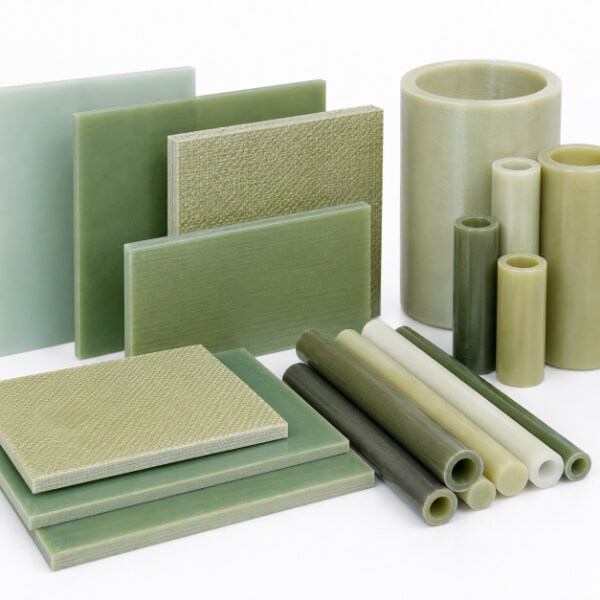
Glass fibre alone is only half the story. The matrix that holds it together – the resin – defines the composite’s personality. Engineers have plenty of options: unsaturated polyester is cheaper, polyurethane cures faster, and vinyl ester offers good chemical resistance. So why choose epoxy?
The answer is rooted in three practical traits that matter every day on the shop floor and in the field:
Dimensional precision – Epoxy resins shrink by merely 1‑3 % during curing, compared to 7‑8 % for polyester. For injection‑moulded or compression‑moulded parts with tight tolerances – think electronic housings or precision gears – this low shrinkage means fewer warped rejects and less post‑machining.
Superior electrical insulation – With a volume resistivity around 3.5×10⊃1;⁶ Ω·cm, epoxy glass is the default dielectric material for printed circuit boards (FR‑4), high‑voltage switchgear, and 5G antenna supports. Polyurethane, in contrast, has significantly lower resistivity and is rarely used in critical insulating applications.
Reliable adhesion and fatigue life – Epoxy bonds aggressively to glass fibres, creating a strong interphase that resists micro‑cracking under cyclic loads. This is why wind turbine blades, which endure billions of load cycles over 20‑25 years, are predominantly built from epoxy glass – not polyester or polyurethane.
In the world of epoxy glass laminates, three names come up more often than any other: FR‑4, G10, and G11. They share the same fundamental composition – woven glass fabric with an epoxy resin binder – but their specific formulations give each a distinct personality. Choosing the right one is like picking the right tool for a job; each excels under different conditions.
Here is how they compare side by side:
| Property | FR‑4 | G10 | G11 |
| Core strength | Flame retardancy | Mechanical strength | Heat resistance |
| Flammability rating | UL94 V‑0 (self‑extinguishing) | UL94 HB (typically non‑flame‑retardant) | Some grades flame‑retardant, some not |
| Glass transition temp. (Tg) | ~130‑140 °C | ~150 °C | 155‑180 °C |
| Max continuous service temp. | ~130 °C | ~150 °C | ~150 °C (strength holds better at high temp) |
| Mechanical performance | Good | Excellent | Superior, especially at elevated temperatures |
| Moisture absorption | Moderate | Low | Low |
| Relative cost | Lowest | Moderate | Highest |
FR‑4 is the undisputed champion of the electronics world. Its “FR” stands for Flame Retardant, and it meets the strict UL94 V‑0 standard, meaning it self‑extinguishes within seconds after the ignition source is removed. This makes it the go‑to material for printed circuit boards – nearly every PCB you have ever seen is made from FR‑4. Beyond boards, it is also used for insulating spacers, terminal blocks, and relay bases in consumer electronics and industrial controls. Its high volume, wide availability, and balanced performance make it the most cost‑effective choice for general electrical applications.
G10 is the older sibling, originally developed for military and aerospace applications where mechanical integrity and electrical insulation were paramount – without a strict flame‑retardancy requirement. It is known for its high flexural and compressive strength, excellent dimensional stability, and very low moisture absorption. Because of these traits, G10 is the material of choice for high‑precision machining – think test fixtures, jigs, gears, bearings, and insulating washers that must hold tight tolerances in changing humidity. It is also widely used in knife handles and archery bow limbs, where strength and lightweight construction are valued.
G11 is G10’s heat‑tolerant cousin. It retains most of G10’s mechanical and electrical prowess but adds a crucial upgrade: superior thermal stability. With a glass transition temperature (Tg) reaching up to 180 °C, G11 keeps its shape and strength even when the environment gets hot. This makes it indispensable in high‑temperature electrical equipment – transformer insulation, motor slot wedges, high‑voltage switchgear, and generator components. It also appears in aerospace interiors and engine‑adjacent brackets where intermittent heat exposure is a given. The trade‑off is a higher price tag, but for applications that run hot and cannot afford failure, G11 pays for itself many times over.
A quick note on FR‑5: If you need both flame retardancy and high heat resistance, look for FR‑5 – it is essentially a flame‑retardant version of G11, combining the best of both worlds.
To see epoxy glass at its best, consider these everyday engineering challenges:
Automotive lightweighting – Replacing a steel engine hood with an epoxy glass composite cuts weight by over 20 % without sacrificing stiffness. For electric vehicles, every kilogram saved extends range, and the cost penalty is modest enough to pass on to consumers.
Marine and offshore – Saltwater corrodes metals and degrades many polymers. Epoxy glass resists both, which is why it is used for sonar domes, propeller shaft fairings, and even the spinning “rotor sails” on modern cargo ships – components that must survive decades of salt spray and rotational fatigue.
Industrial corrosion control – Chemical plants use epoxy glass for acid storage tanks, scrubber ducts, and pump casings because it handles aggressive media while being lighter and easier to install than stainless steel or lined carbon steel.
Electrical enclosures – From circuit breaker housings to transformer insulation rods, epoxy glass provides the creepage distance and arc resistance that safety standards demand – all in a mouldable, flame‑retardant package.
Based on the trade‑offs discussed, you should reach for epoxy fiberglass composites when your project meets any two of these conditions:
You need high strength‑to‑weight ratio, but your budget cannot absorb carbon fibre pricing.
Your part must hold precise dimensions across temperature and humidity changes.
Electrical insulation is non‑negotiable – you are working with voltages above 1 kV or high‑frequency signals.
The component will face cyclic loading, vibration, or impact – fatigue life matters more than ultimate tensile strength.
Chemical exposure (acids, alkalis, solvents) is part of the operating environment.
And within the epoxy glass family, apply this simple rule of thumb:
Need flame retardancy and general electronics? Pick FR‑4.
Need pure mechanical strength and precision, no fire rating required? Pick G10.
Need heat resistance that lasts, even under electrical load? Pick G11.
Need both flame retardancy and high heat resistance? Choose FR‑5.
If, on the other hand, you are chasing absolute minimum weight at any cost, go carbon. If you need ultra‑fast cycle times and can tolerate some porosity, polyurethane might be worth a trial. But for the vast middle ground – the structural brackets, enclosures, housings, blades, and pipes that keep modern industry running – epoxy glass remains the default, dependable choice that balances performance, processability, and price like no other.
The best material is rarely the strongest or the cheapest – it is the one that gives you just enough performance, with the fewest compromises elsewhere. Epoxy fiberglass composites have earned their place not by being spectacular in one metric, but by being remarkably good in almost all of them. When you next review a bill of materials, ask yourself: “Do I really need carbon fibre here, or do I need a solution that works, lasts, and pays for itself?” More often than not, the honest answer will point you straight to epoxy glass – and with the right grade selection, you will have a solution that is as precise as it is practical.


