
Views: 0 Author: Fenhar Publish Time: 2026-04-10 Origin: Site


Ask most hardware engineers what holds a circuit board together, and they’ll point to copper traces or solder joints. But the real backbone – the one that takes heat, mechanical stress, and high-frequency signals every second – is the substrate.
Without a stable substrate, your carefully routed PCB becomes a gamble. Traces lift. Impedance drifts. Layers separate after a few thermal cycles. And none of that shows up in a schematic.
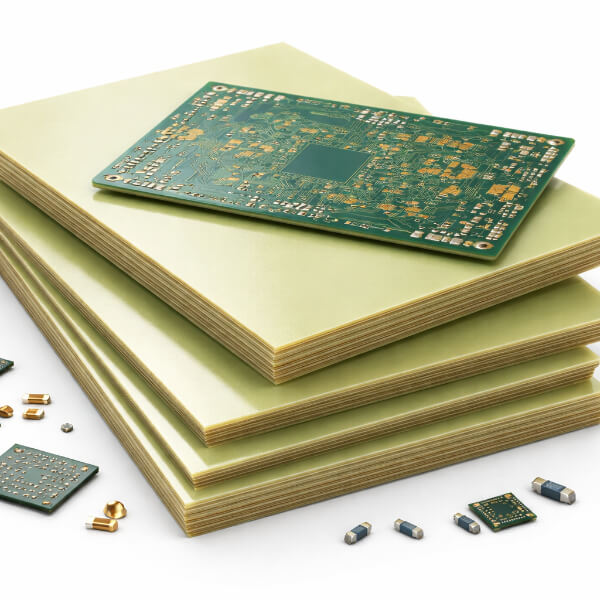
A substrate is the insulating base that carries copper foil on one or both sides. It provides mechanical rigidity and electrical isolation between conductive layers. In rigid boards, it’s almost always a glass-reinforced epoxy laminate – what the industry loosely calls FR-4.
But “FR-4” isn’t a fixed recipe. Different manufacturers use different glass weaves, resin systems, and cure cycles. That’s why two boards marked FR-4 can behave completely differently on a reflow line or inside a thermal chamber.
If you only look at copper weight and board thickness, you’re missing what actually drives performance. Pay attention to these instead:
Glass transition temperature (Tg) – the point where the material softens from rigid to rubbery. Low Tg boards warp and delaminate faster. High Tg (170°C or above) is standard for lead-free assembly.
Thermal decomposition temperature (Td) – the temperature where the material starts losing mass. When Td is too close to your soldering peak, you get outgassing and pad cratering.
Z-axis expansion – as the board heats up, it expands vertically. Excessive expansion cracks plated through-holes. This is a silent failure that often shows up months after production.
Dielectric constant (Dk) and dissipation factor (Df) – for anything above a few hundred MHz, these determine signal loss and impedance consistency. Many standard laminates have Dk that changes with temperature and frequency.
PCB substrate is glass fabric impregnated with epoxy resin. The gap between glass bundles creates a “weave effect” that can cause skew on differential pairs and uneven dielectric constant across a board.
Some designs require spread glass or open-weave styles to control this. Most generic boards ignore it – until high-speed signals start failing eye diagrams.
Resin content also matters. Too little resin leaves voids near copper surfaces, reducing voltage breakdown strength. Too much resin increases thermal expansion and softens the board. Good substrate manufacturing tracks resin percentage to a tight window – not “somewhere between 40 and 50 percent”.
The base material changes with layer count:
Single-sided uses a standard core with copper on one face – simple, low-cost, still used in power supplies and sensors.
Double-sided has copper on both sides of the same core. That’s the most common format for general-purpose boards.
Multilayer stacks multiple cores and prepregs (partially cured sheets that bond cores together). In this case, the substrate is no longer a single sheet – it’s a combination of cured cores and uncured bonding material that becomes solid during lamination.
For multilayer builds, the consistency of each core’s thickness and copper peel strength directly affects yield. Variations as small as 10 microns in core thickness can throw off controlled impedance by several ohms.
Many PCB fabricators buy laminates from large traders who resell whatever batch is cheapest that week. The fabricator may not even know which glass style or resin system they just received – only that it passes a basic incoming test.
That works for simple blinkers and power adapters. It fails for anything with tight thermal or high-speed requirements.
Manufacturers that actually produce their own substrates – like Fenhar, as one example – keep full control from glass fabric to finished laminate. That means every batch has traceable cure parameters, glass weave records, and actual test data, not just a generic datasheet.
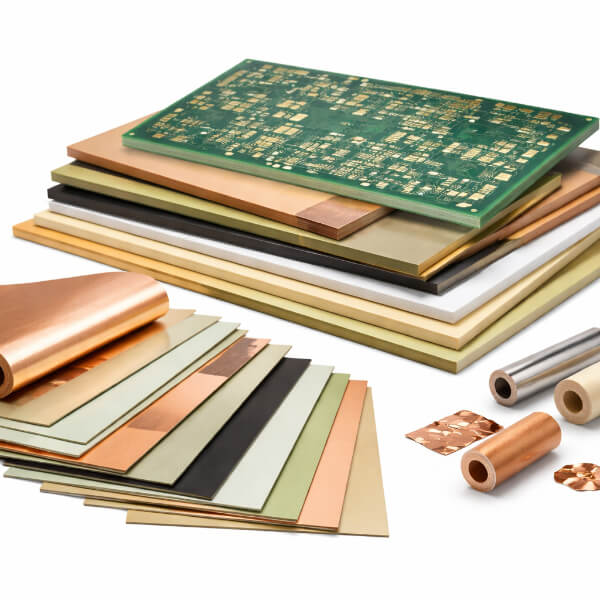
If you want to avoid surprises, ask these three questions before ordering:
What is the exact Tg, Td, and Z-axis expansion of the substrate you will use?
Do you control glass weave style for differential pairs on this design?
Can you provide batch-level laminate certificates, not just material declarations?
Low-cost consumer products – standard FR-4 with 130–140°C Tg works fine.
Industrial control and automotive – high-Tg (170°C min) and controlled Z-axis expansion.
RF and high-speed digital (above 1 Gbps) – low-loss materials with tightly specified Dk/Df and spread glass.
Thick copper or heavy thermal cycling – look for high Td (over 340°C) and high peel strength.
No single substrate fits every board. But understanding what happens inside that beige or green laminate sheet puts you back in control of your design’s real-world performance.


