
Views: 0 Author: Fenhar Publish Time: 2026-07-31 Origin: Site


Composite laminates are among the most versatile material systems in modern engineering. By combining a reinforcing fiber with a polymer matrix, these materials achieve performance characteristics that are simply unattainable with metals or plastics alone. The fundamental principle is synergy: the composite delivers a balance of strength, weight, and durability that is tailored to the demands of the application.
Understanding the structure is the first step to effective material selection. A typical composite laminate is built on two foundational elements:
The Reinforcement: This provides the mechanical strength and stiffness. Fibers are the most common reinforcement. Glass fibers (GFRP) are the workhorse of the industry, offering a high strength-to-weight ratio at a cost-effective price point. For maximum performance, carbon fibers (CFRP) deliver exceptional stiffness and strength but come at a premium. Natural fibers, such as flax or hemp, are gaining traction in applications where sustainability is a primary concern.
The Matrix: This is the binder that holds the reinforcement together, protects it from environmental damage, and transfers load between the fibers. Thermoset resins like epoxy and polyester cure irreversibly and are known for their thermal stability and resistance to creep. In contrast, thermoplastic resins like polypropylene (PP) and nylon can be reheated and reformed, offering superior impact toughness and the benefit of recyclability.
A third structural category, the sandwich panel, introduces a lightweight core material between two thin, high-strength skins. This design dramatically increases the panel's bending stiffness with minimal weight gain. Common core materials include aluminum or aramid honeycombs, rigid foams (such as PVC or PET), and end-grain balsa wood.
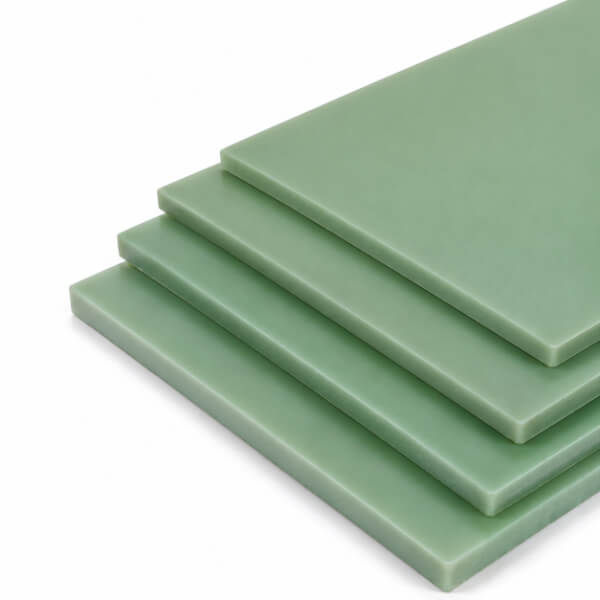
The method used to produce a composite laminate has a direct impact on its final properties and cost. Several processes dominate the industry:
Hand Lay-up and Spray-up are the simplest and most flexible methods. They involve manually placing fiber and resin into a mold. While labor-intensive, they are ideal for large, complex parts produced in small volumes.
Compression Molding uses a heated metal mold and pressure to shape a pre-formed sheet. This process is highly efficient, delivers excellent dimensional accuracy, and is the go-to choice for high-volume production runs.
Pultrusion is a continuous process used to create profiles with a constant cross-section. Fibers are pulled through a resin bath and then through a heated die that cures the material. This is the standard method for producing structural profiles like beams and grating.
For the highest performance, Vacuum Bagging and Autoclave Curing are the gold standards. By curing the material under both heat and high pressure, these processes produce parts with incredibly low void content, resulting in superior mechanical properties—a critical requirement in aerospace and racing applications.
The ability to fine-tune a laminate's properties has driven the adoption of composites across virtually every sector.
Aerospace and Aviation: These materials are the backbone of modern aircraft, forming the primary structure of fuselages, wings, and tail assemblies. Every kilogram saved translates directly to reduced fuel consumption and increased range.
Transportation: In the automotive industry, composites are used for both exterior body panels and lightweight interior structures. Their use is expanding in high-speed rail and marine vessels for similar reasons—durability and weight reduction.
Construction and Infrastructure: Composite laminates are the material of choice for light-weight, high-strength building facades, roofing systems, and interior decorative surfaces. Their corrosion resistance makes them invaluable for bridge decks, cooling towers, and chemical plant flooring.
Renewable Energy: The long, slender blades of modern wind turbines are a testament to the capability of composites. These structures, often exceeding 80 meters in length, must be both incredibly light and immensely strong—a feat only achievable with materials like GFRP.
While the general categories are essential, engineers often work with specific, standardized grades. In the realm of thermoset epoxy laminates reinforced with woven glass fabric, a clear hierarchy of grades exists, each defined by its performance against heat and fire.
The global industry typically refers to standards from the U.S. National Electrical Manufacturers Association (NEMA) and the International Electrotechnical Commission (IEC).
| NEMA Grade | IEC Equivalent | Core Profile | Defining Property & Standard | Primary Applications |
| G-10 | EPGC201 | The Standard-Bearer. It is the baseline grade, known for outstanding mechanical strength and dielectric properties. | Offers excellent strength but no flame retardancy (typically UL 94 V-2 or HB). | General-purpose electrical insulation, machined structural parts, and premium knife handles. |
| FR-4 | EPGC202 | The Industry Workhorse. This is the flame-retardant version of G-10 and is, by far, the most widely used grade globally. | Certified to UL94 V-0, the highest level of flame retardancy. Excellent mechanical and electrical stability. | The universal material for PCB substrates, electronic mounting boards, and motor insulation. |
| G-11 | EPGC203 | The High-Temperature Specialist. This grade is formulated to retain its strength when the heat is on. | Rated as Class F (withstands up to 155°C continuously). Superior hot strength retention. | Electrical and structural components that must operate reliably in elevated-temperature environments. |
| FR-5 | EPGC204 | The Ultimate Protector. It combines the thermal resilience of G-11 with the fire safety of FR-4. | Certified UL94 V-0 and rated as Class H and F (Withstands up to 180°C). | High-performance electronics and electrical systems with the most demanding combined requirements for heat and fire safety. |
The four main grades provide a clear framework, but there are other essential variants to consider.
The Chinese Standard: Grade 3240 is the dominant generic epoxy glass laminate in the Chinese market. Its performance is broadly comparable to G-10/FR-4, though its thermal rating is often classified as Class B (130°C). It remains a reliable and cost-effective option for many general-purpose applications.
Advanced IEC Grades like EPGC306 and EPGC308 represent the next generation of materials. EPGC306 is a halogen-free flame-retardant product featuring a high Comparative Tracking Index (CTI), making it inherently safer for high-voltage environments. EPGC308 builds on that with a High Glass Transition Temperature (Tg) of 180°C, ensuring structural integrity even at extreme temperatures.
Premium Manufacturer Series: Companies like Norplex-Micarta offer specialized series such as the NP Series (e.g., NP510A for FR-4, NP500A for G-10), while the Durostone® product line provides laminates tailored for specific industrial niches, with some variants capable of withstanding up to 300°C.
Understanding the testing standards used to quantify a laminate's performance is crucial for making an informed decision.
Flame Retardancy (UL 94): This test measures how quickly a material stops burning after the ignition source is removed. V-0 is the most stringent classification, requiring self-extinguishment in under 10 seconds. This is non-negotiable for safety-critical electronic components.
Thermal Rating: This defines the maximum continuous operating temperature for the material. The standard classifications are Class B (130°C), Class F (155°C), and Class H (180°C). Exceeding these limits can cause the material to deform or lose its insulating properties.
Glass Transition Temperature (Tg): This is the temperature at which the polymer matrix undergoes a phase change, from a rigid, glassy state to a softer, rubbery state. A High Tg (>170°C) is essential for applications that undergo soldering or high-power operation, ensuring the laminate maintains its dimensional stability.
Comparative Tracking Index (CTI): This is a measure of a material's resistance to electrical breakdown along its surface when exposed to contamination and moisture. A High CTI (≥600V) is a critical safety feature for high-voltage and high-humidity environments.
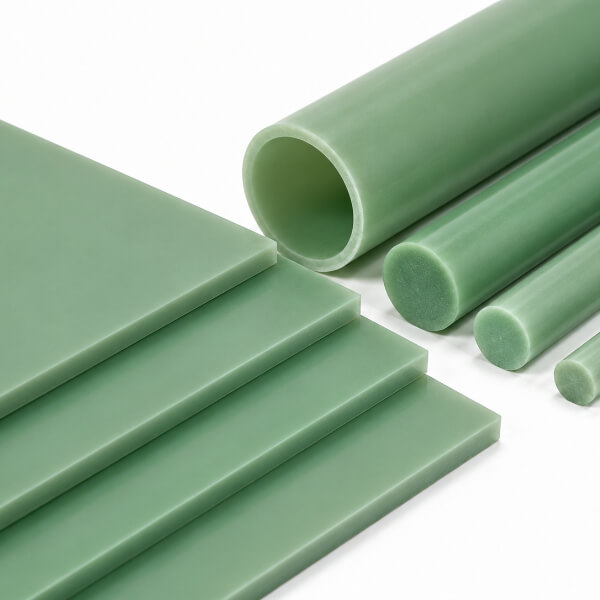
When sourcing epoxy glass laminates, they are typically available in a standardized range of dimensions:
Thickness: Ranges from 0.1 mm to over 150 mm.
Standard Sheet Sizes: Common dimensions include 1020 x 1220 mm, 1020 x 2040 mm, and 1220 x 2440 mm.
Color: Natural (light green), yellow, black.
Machinability: These materials are relatively easy to machine using standard workshop tools. They can be cut, drilled, milled, turned, and tapped. High-pressure water-jet and laser cutting are also widely used for intricate geometries.
The path to the correct composite laminate begins with a simple question: what are the operating conditions?
No flame retardancy needed, general strength? Choose G-10.
Flame retardancy is a requirement? Choose FR-4—this is the default choice for a reason.
High-temperature operation? Choose G-11.
Both high heat and high fire safety? Choose FR-5.
Need a high safety index for electronics? Look into halogen-free, high-CTI grades like EPGC306.
By mapping the environmental demands of your project against the specific, quantifiable properties of these grades, you can select the material that offers the optimal balance of performance, safety, and cost.


