
Views: 0 Author: Fenhar Publish Time: 2026-10-10 Origin: Site


For most buyers the copper-clad laminate (CCL) lives in the printed-circuit world and the laminated insulation sheet lives in the electrical-apparatus world, and never the twain shall meet. That separation is an accident of where the material is used, not of what the material is. This guide tears down the wall: it shows that a CCL and a bare insulation laminate often share the very same base, explains the precise point where their requirements split, and gives you a practical way to specify across the boundary.
A copper-clad laminate is a sandwich: a thin copper foil bonded to one or both faces of an insulating base, built under heat and pressure. Multilayer versions add prepreg—resin-impregnated glass fabric—between sheets to glue the stack together. The copper becomes traces, pads, and planes after etching; the insulating base does everything else. That base is the part this article cares about, because it is the same reinforced thermoset that industrial laminators sell without copper. We are not re-explaining CCL construction here—we are asking what the foil is hiding.
Strip the foil away and an FR-4 CCL and a bare FR-4 sheet are chemically the same object. Both are:
Reinforcement: woven E-glass fabric—the "glass" in glass-epoxy. It carries the mechanical load and sets dimensional stability.
Matrix: a thermosetting epoxy resin, cured into a rigid, cross-linked network that binds the fabric and supplies the dielectric body.
Flame-retardant grade: the "FR" in FR-4 denotes the self-extinguishing package. In practical terms it is the flame-retardant cousin of NEMA G-10. Modern bare FR-4 and G-10 share the reinforcement and matrix and differ mainly in a halogen- or phosphorus-based retardant addition.
This is the core insight: FR-4 is not a "circuit-board material." It is a glass-epoxy laminate that happens to be sold both with and without copper. The same is true higher up the temperature scale—G-11 is the high-glass-transition-temperature epoxy grade that appears both as a high-Tg CCL base and as a bare Class F/H insulation sheet. Polyimide appears as flexible CCL (FCCL) and as bare film. The resin-reinforcement system is the constant; the copper is the variable. A purchasing agent who buys FR-4 CCL by the panel and FR-4 sheet by the plate is buying the same chemistry twice under two different part numbers.
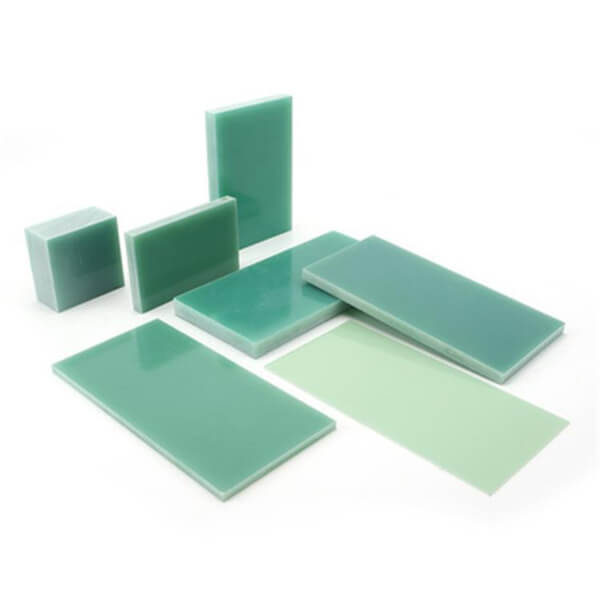
The chemistry is shared; the acceptance criteria are not. A CCL is bought against electrical-performance and fabrication specs that assume copper is present and signals are flowing. A bare insulation laminate is bought against isolation and structural specs that assume no conductor and a dielectric field is doing the work. The table contrasts the two.
| Specification category | Governs CCL (with copper) | Governs bare insulation laminate |
| Dielectric properties | Dielectric constant (Dk) and loss factor (Df) controlled for signal integrity at frequency | Dielectric strength (kV/mm) and insulation resistance for isolation |
| Copper interface | Peel strength, foil surface roughness, CAF resistance | Not applicable—no copper present |
| Thermal behavior | Z-axis CTE, Tg, Td for via and reflow reliability | Thermal class (IEC 60085), moisture absorption, creepage design |
| Surface behavior | Etchability, solder-mask adhesion | Arc resistance, CTI (tracking), contamination tolerance |
| Mechanical | Light handling, flatness for fine features | Flexural and compressive strength for supports, spacers, barriers |
| Thickness | Tight tolerance, thin (roughly 0.1–3.2 mm) | Wide range, can be thick structural sections |
Dk and Df are the CCL owner's headaches; a bare insulator rarely reports them because it is not carrying signals. Conversely, arc resistance and comparative tracking index (CTI, per IEC 60112) are the insulation owner's specs; a CCL datasheet may list CTI but does not design around tracking the way a switchgear barrier does. Glass-transition and decomposition temperatures (Tg, Td) matter to both—reflow survival for the CCL, thermal class for the insulator—but for different reasons and against different duty cycles.
A bare laminate is chosen precisely because there is no copper. In a live-barrier insulator, a busbar support, a transformer spacer, or a switchgear partition, embedded or surface copper is a liability: it can create an unintended conductor, spur eddy-current heating under AC fields, or introduce a galvanic path between dissimilar metals. "Unclad" is therefore a feature, not a cost-saving omission. When a specifier reaches for "FR-4," the first question is not "which FR-4" but "do I need copper at all?" If the job is isolation or support, the bare grade is correct—and usually lower cost per function because nobody paid to bond and test foil.
Insulated metal substrate (IMS) and metal-core boards look like they break the shared-base rule, but they actually confirm it. In an IMS board, a thin (typically 50–200 µm) thermally conductive dielectric layer sits between the copper circuit and an aluminum or copper base. That dielectric is not a structural laminate—it is a bonded film whose only job is to move heat while blocking voltage. It is a different insulation strategy from a thick FR-4 sheet, and it should not be specified where a structural laminate is needed. For power-module baseplates, ceramic insulators (aluminum nitride, alumina) or direct-bonded copper on insulated metal carry the isolation. The lesson: when heat dominates, the "insulator" shrinks to a thin layer; when structure and isolation dominate, you want the full laminate—bare.
A four-question check keeps the choice honest:
Do you need conductive traces? → copper-clad laminate (with copper).
Do you need dielectric isolation or structural support with no conductor? → bare insulation laminate (FR-4/G-10, G-11, GPO-3, G-7).
Is heat the dominant constraint and do you need a heatsink-integrated dielectric? → IMS / metal-core (thin dielectric, not a laminate).
Match the duty, not the label: same epoxy-glass chemistry; pick thermal class and flame rating to the application.
The grade cross-reference below maps the CCL base grades you already know to the bare insulation grades that do the same chemistry's isolation job.
| CCL base grade | Bare insulation equivalent | Notes |
| FR-4 / G-10 | FR-4, G-10 sheets | Same epoxy-glass; bare used for supports, spacers, barriers (≈ Class B 130°C) |
| High-Tg FR-4 / G-11 | G-11 sheet (Class F/H) | Higher Tg for lead-free reflow and hotter duty |
| Polyimide (FCCL) | Polyimide film / rigid PI | Flex and high-temperature; flex CCL vs bare film |
| GPO-3 (bare only) | GPO-3 sheet | Glass-polyester, arc- and track-resistant; no common CCL analog |
| G-7 (bare only) | G-7 sheet | Melamine-glass, highest arc resistance; insulation-grade only |
GPO-3 and G-7 have no real CCL counterpart because their value is arc and tracking resistance in open-air equipment—exactly the environment where copper is unwanted. If your selection problem lives in a cabinet rather than on a circuit, the bare catalog is where you start.
"FR-4" describes a material family, not a copper product. Bare FR-4 is the same chemistry unclad.
Buy CCL against signal and fabrication specs; buy bare laminate against isolation and structure specs. Do not borrow one world's criteria for the other.
Choose bare whenever copper would be a hazard or is simply unnecessary. Unclad is a design decision, not a downgrade.
Use IMS only when heat—not structure—drives the insulation need. A thin dielectric is not a substitute for a structural laminate.
When in doubt on a grade for an electrical-insulation duty, start from the bare laminate catalog, not the CCL catalog.
A copper-clad laminate has copper foil bonded to one or both faces of an insulating base; a bare laminate is that same base with no copper. They share the reinforcement and resin system, and they differ mainly in which specifications govern them—signal and fabrication criteria for CCL, isolation and structural criteria for bare laminate.
Chemically they are close: FR-4 is the flame-retardant version of the same epoxy-glass system that NEMA designates G-10. Both use woven E-glass fabric in a thermosetting epoxy matrix; FR-4 adds the self-extinguishing package. A bare FR-4 sheet is, in practical terms, flame-retardant G-10, and it is sold both with and without copper.
Whenever the part must insulate or support a structure with no conductor present—live barriers, busbar supports, transformer spacers, switchgear partitions—copper is a hazard or simply unused mass. Embedded or surface copper can create an unintended conductor, spur eddy-current heating, or introduce a galvanic path. Unclad is the correct, often cheaper, choice for those duties.
Conductive anodic filament (CAF) is a failure mode where a conductive path grows through the glass-epoxy under sustained bias and humidity, driven by the copper electrodes. It requires copper to form, so it is a copper-clad and multilayer concern. A bare unclad sheet has no copper to grow filaments, so CAF is not a relevant acceptance criterion for it.
Yes. The base material is the same glass-epoxy, so cutting, drilling, and milling behave alike. The practical difference is that with a bare sheet you are not protecting foil or fine etched features, so the main shop concerns are dimensional tolerance, edge quality, and dust extraction rather than preserving a circuit layer.
For live barriers and arc- or tracking-exposed parts, select bare grades built for that duty: GPO-3 or G-7 where arc and tracking resistance dominate, and FR-4/G-10 or G-11 for general isolation and support, chosen by thermal class. These are the grades that have no meaningful copper-clad counterpart because their value is isolation in open-air equipment.


