
Views: 0 Author: Fenhar Publish Time: 2026-06-18 Origin: Site


Walk into any electrical room or aerospace assembly bay, and you will find G10, FR4, and G11 laminates doing exactly what they were designed to do: holding tight tolerances, resisting creep, and keeping high voltages safely isolated. In that sheltered environment, their service life easily stretches into decades.
But take that same board and mount it on a transmission tower, a rooftop antenna mast, or an industrial chemical line, and the performance narrative flips. The issue is rarely a single culprit. It is the unrelenting, overlapping assault of temperature shifts, moisture cycles, surface contaminants, and yes, solar radiation—all acting on the laminate simultaneously. Engineers who treat outdoor exposure as a "UV problem" often miss the more insidious degradation drivers that actually pull the trigger.
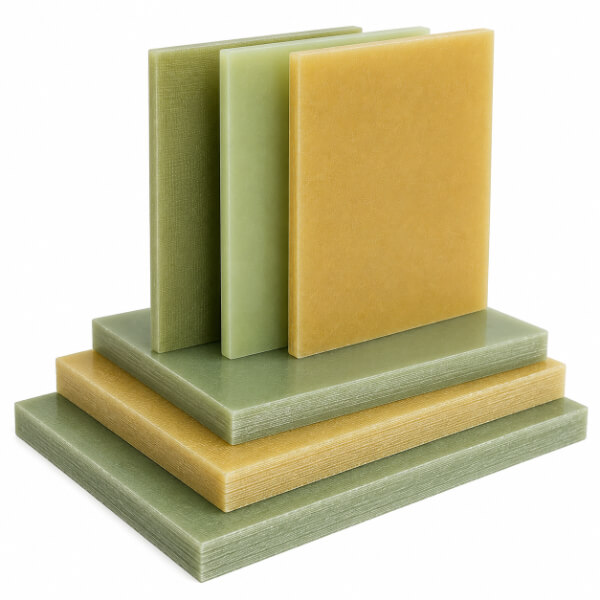
Epoxy glass laminates are thermosets, which means they cure into a rigid, crosslinked network. That network expands and contracts with temperature changes at a specific coefficient of thermal expansion (CTE). While the glass fabric reinforcement restricts bulk movement, the resin-rich surface layer responds more freely to thermal swings.
Here is the overlooked risk: daily temperature cycling—especially in desert or high-altitude environments—induces repeated micro-strain on the resin surface. Over hundreds of cycles, this fatigue accumulates. Even without direct sunlight, thermal expansion and contraction can generate internal stresses at the glass-resin interface. When you combine this with UV-induced embrittlement, the resin loses its ability to accommodate that cyclic strain. The result is not just surface crazing, but deeper interfacial debonding that compromises the composite's structural integrity well before the glass fibers themselves show any sign of distress.
Humidity and liquid water present a more immediate threat to electrical performance than to mechanical strength. G10, G11, and FR4 are generally rated for low moisture absorption—often below 0.5% by weight in controlled tests—but that rating assumes an intact, uncracked surface.
Once thermal fatigue or UV erosion creates the smallest fissure, water finds its way in. But moisture ingress is not just about weight gain. The real engineering headache is what happens during wet-dry cycling. As trapped moisture evaporates, it leaves behind dissolved ionic contaminants from the air or from the laminate's own flame-retardant additives. These residues can form conductive bridges across insulating surfaces, gradually lowering surface arc resistance and tracking performance. In high-voltage outdoor gear, this pathway often leads to dielectric failure long before the board loses its bending strength.
Outdoor and industrial environments are rarely clean. Ozone, sulfur dioxide, and industrial particulates settle on exposed laminate surfaces. Unlike the photochemical reactions driven by UV, these chemical agents can directly attack the epoxy backbone through hydrolysis or oxidation, particularly at elevated temperatures.
The brominated flame retardants used in standard FR4 add another layer of complexity. While they provide essential fire safety, these halogenated compounds can undergo dehydrohalogenation under prolonged thermal or UV stress, releasing acidic byproducts that autocatalyze further resin breakdown. That is why FR4 cannot simply be treated as a flame-retardant version of G10 in outdoor specs; its degradation chemistry diverges significantly, especially when heat and humidity are present.
You will occasionally encounter a specific data point circulating in technical discussions: up to 21% reduction in mechanical properties—impact, flexural, and tensile—after 720 hours of accelerated exposure. That number is valuable as a risk indicator, but it carries a heavy dependency on test protocol. Was the sample subjected to condensation cycles alongside UV? What was the black-panel temperature? How often did the humidity ramp up and down?
The engineering takeaway is this: 720 hours in a weathering chamber represents an accelerated snapshot of a particular set of aggressive conditions. In real outdoor installations, the degradation clock runs slower, but it runs continuously across multiple axes—temperature, moisture, and chemistry—simultaneously. A material that survives 720 hours of pure UV may fail catastrophically in 500 hours when thermal cycling and salt fog are added to the mix.
Choosing between G10, G11, and FR4 for a harsh environment requires looking beyond the datasheet's headline numbers.
G10 delivers reliable mechanical and dielectric performance at moderate temperatures. Its lack of flame retardant additives means one less source of potential degradation chemistry, but its continuous-use temperature ceiling is lower than G11. When humidity is the primary concern, G10 performs admirably—provided the surface stays intact.
G11 steps in when the application demands sustained operation at elevated temperatures. Its modified resin system retains flexural strength at higher thermals, but that thermal stability does not confer immunity to moisture absorption or UV attack. It is a heat-resistant material, not a weatherproof one.
FR4 remains the default for electrical insulation requiring flame retardancy. However, the brominated epoxy chemistry makes its aging behavior less predictable under combined thermal and photochemical stress. If your outdoor application demands FR4, expect to validate it explicitly under the specific environmental profile of the installation site—do not assume G10 data applies.
If a design review flags G10, G11, or FR4 for outdoor exposure without protection, do not immediately abandon the material. Several pragmatic mitigation strategies can extend service life significantly:
Coating is the first line of defense. A well-adhered epoxy or polyurethane topcoat seals the surface, blocking moisture penetration and reflecting a significant portion of incident UV. This decouples the laminate's base formulation from the direct environment, often the most cost-effective intervention.
Physical shielding and orientation. Simply angling the board to minimize direct sunlight, rain impingement, and dust accumulation reduces the intensity of all environmental drivers simultaneously. An opaque cover or enclosure eliminates the need for UV stabilization altogether.
Drainage and ventilation. Stagnant moisture is the enemy. Designing for positive drainage and allowing airflow across the surface prevents the formation of localized wet zones that accelerate hydrolysis and tracking.
Accept that stabilization has limits. UV absorbers and HALS additives can slow photo-oxidation, but they do nothing for thermal cycling fatigue or chemical attack. They are supplements, not substitutes, for good environmental design.
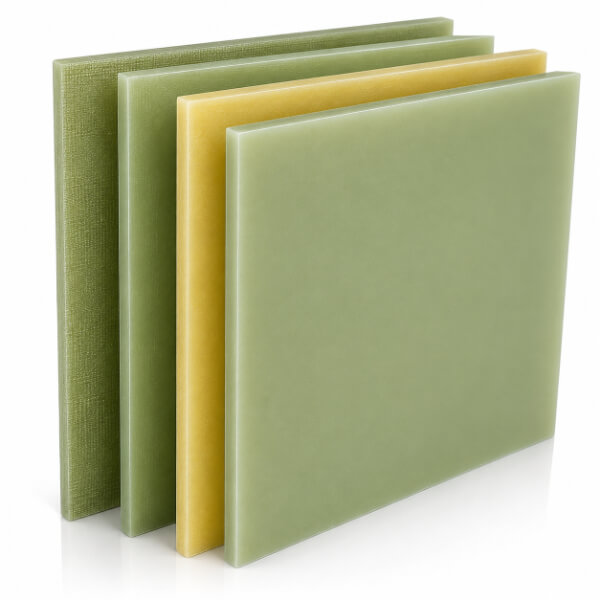
G10, G11, and FR4 earned their reputation as reliable engineering materials through decades of proven indoor service. But the outdoor environment is not merely a harsher version of indoor conditions—it is an entirely different operational regime. The degradation pathways are coupled: UV embrittles, thermal cycling cracks, moisture penetrates, and contaminants conduct.
The most effective approach is to view these laminates as components of a system, not standalone barriers. When you pair a well-chosen grade with proper coatings, thoughtful orientation, and routine inspection intervals, you can extract reliable outdoor service from them. When you omit those protections, do not be surprised when a 21% drop in strength becomes the least of your concerns—long before the board fails, its electrical tracking resistance and dielectric margin will have already compromised your application's safety margin.


