
Views: 0 Author: Fenhar Publish Time: 2026-06-09 Origin: Site


When a component has to do more than just sit there and not conduct electricity, design teams often find themselves looking beyond standard plastics or metals. Metals bring conductivity risks. Regular plastics can creep, soften, or warp under load or heat. What you need is something that isolates, holds shape, withstands heat or humidity, supports hardware, and still machines cleanly to tight tolerances.
That combination of demands is exactly where thermoset composite laminates tend to come in.
These are not the same as the thermoplastics you might use for injection-molded housings. Thermosets cure permanently. They don’t melt or reflow under heat. And when reinforced with glass fabric, they become rigid, stable, and surprisingly strong for their weight.
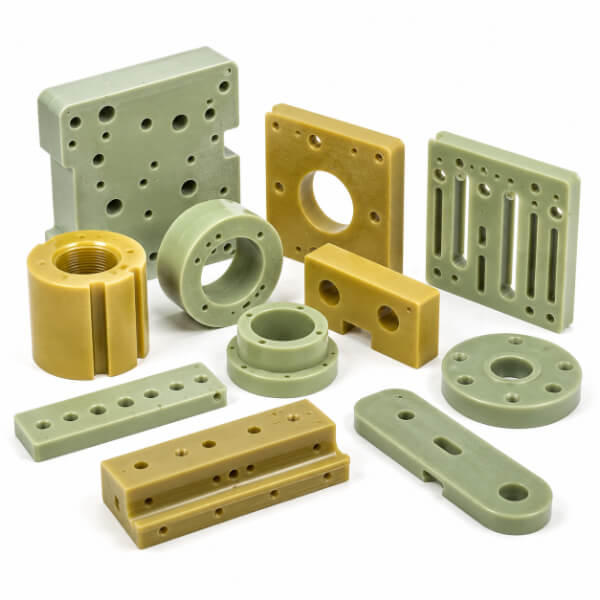
Walk through a typical power distribution setup or open a switchgear cabinet, and you will likely find machined thermoset components inside. Phase separators, insulating barriers, arc shields, terminal boards, busbar supports, standoffs, spacers, washers, sleeves, mounting plates — the list is longer than most engineers realize.
In switchgear, these parts help keep phases apart and maintain safe spacing inside high‑voltage assemblies. In transformers, they show up as rigid supports or insulating barriers that don’t break down over time. Battery racks and energy storage systems also use them, especially where you want electrical isolation combined with thermal stability and a non‑metallic construction.
The common thread? The part has to do multiple jobs at once. Not just “don’t conduct,” but also hold a load, keep a precise shape, resist flame or heat, and behave the same way part after part after part.
Picking the wrong grade is a classic trap. Engineers sometimes call out a material by name — say, G10 or FR‑4 — without thinking through the real operating environment. That works fine until the part sees higher temperatures, moisture cycling, or unexpected mechanical stress.
Here is what actually drives material selection for electrical insulation applications:
Dielectric strength (how well it stands off voltage)
Flame rating (critical for many UL or IEC applications)
Moisture resistance (some grades absorb less than others)
Thermal stability (will it hold dimensions at 130°C or higher?)
Mechanical rigidity and strength
Machinability (can you drill tight holes without delamination?)
The glass epoxy family — G10, G11, FR‑4, FR‑5 — covers most of this ground. G10 and G11 are known for stable mechanical and insulating properties. FR‑4 and FR‑5 add flame retardancy and tighter dimensional control. But the right choice always starts with a simple question: what does the part actually have to survive?
Voltage level, creepage and clearance distances, peak temperature, humidity, expected load, and how the part gets inspected — all of that matters more than the material name alone.
In electrical assemblies, fit drives function. A machined barrier, spacer, or terminal board that is off by a few tenths of a millimeter can shift how hardware aligns, how much creepage distance remains, or whether the part seats correctly during assembly.
Thermoset laminates do not machine like aluminum or acetal. They are abrasive, layered, and sensitive to tooling choices. Poor machining leads to fuzzing at edges, breakout around holes, delamination between plies, or smearing of resin. For an insulating part, any of those defects can cause rework, assembly delays, or — in a worse case — a field issue that nobody wants to explain.
Good machining means controlling feed rates, using sharp carbide or diamond tools, supporting edges properly, and managing heat. More importantly, it means designing with manufacturing in mind. A design that requires blind pockets, extremely thin walls, or tight tolerances on unsupported edges may work as a one‑off prototype but fail in recurring production.
The real goal is not one acceptable part. It is the same clean, accurate component every time you run the job — especially when moving from prototype to regular production.
A practical way to narrow down material grades is to match them to the part’s job.
If the component is a simple insulating support in a clean, dry, moderate‑temperature environment, a standard G10 or FR‑4 is often fine.
If the part must retain its insulating and dimensional performance at elevated temperatures for long periods, G11 or FR‑5 becomes a better fit.
If flame retardancy is a hard requirement — and in most switchgear and transformer applications, it is — start with FR‑4 or FR‑5 rather than trying to add it later.
Geometry also matters. A flat insulating panel, a drilled terminal board, a thin spacer, a machined sleeve, and a load‑bearing support all point toward different material and machining trade‑offs. Thickness, laminate direction, how fasteners are used, tolerance stacks, and edge finish all influence both grade selection and manufacturing approach.
Sometimes the best question to ask is not “which grade?” but “what does this component need to survive, support, isolate, and repeat?”
Waiting until drawings are locked and materials are specified is often too late. The time to involve someone who works with thermoset composites every day is before finalizing the design — especially when any of these are true:
High‑voltage requirements (creepage and clearance become critical)
Tight tolerances on holes, thickness, or flatness
Flame‑rating requirements that must be documented
Exposure to sustained heat, temperature cycling, or moisture
Complex machined features (multiple pockets, counterbores, or threaded inserts)
Fastened interfaces with metal hardware
Plans for recurring production, not just a few prototypes
Early input helps confirm that the selected material actually fits the operating environment. It also identifies whether the part geometry can be machined repeatedly without defects. Often, a small change in thickness, edge finish, or hole placement makes the difference between a part that works reliably in production and one that causes constant headaches.
Experts can also suggest practical alternatives — like adding bushings, changing insert types, or adjusting tolerances — that keep the electrical performance intact while making machining simpler and more consistent.
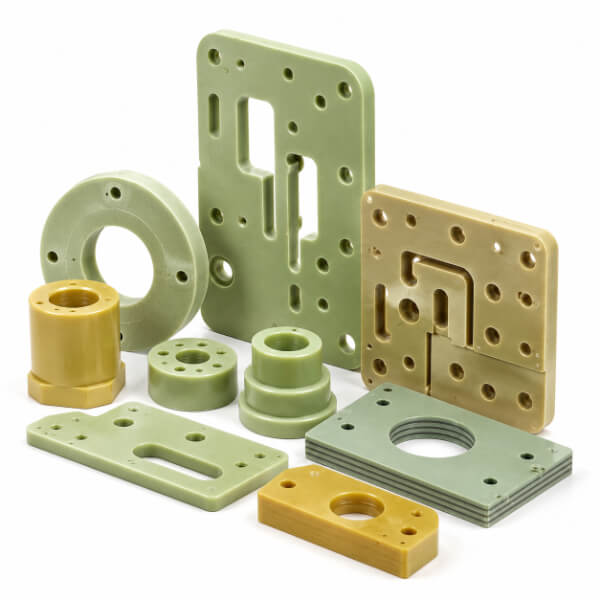
Thermoset composites get chosen for a reason. They bring together electrical insulation, mechanical strength, dimensional stability, and machinability in a way that few other material families can. But that potential only shows up when the requirements are understood early and matched to the right grade and machining process.
For electrical engineers, the goal is simple: a component that insulates correctly, fits the assembly every time, and moves smoothly from prototype to production. When you start with a clear picture of what the part has to survive and how it will be machined, machined composite components stop being an afterthought — and become a reliable part of the system.


