
Views: 0 Author: Fenhar Publish Time: 2026-11-26 Origin: Site


A step washer — also called a shoulder washer or shouldered insulating bushing — is a single machined part with two distinct regions. The flat flange sits under the bolt head or nut and insulates the metal from the clamping surface. The cylindrical shoulder passes through the mounting hole and insulates the bolt shank from the hole wall. In the catalogue trade these are sometimes sold as separate items: a flat washer here, an insulating sleeve there. In an assembly they are one electrical problem.
That is the point most product pages miss. A bolted joint through a live conductor creates two leakage paths at once: one straight down through the laminate beneath the head, and one radially from the shank to the edge of the hole. A flat washer defends only the first. A sleeve dropped into the hole defends only the second, and leaves a joint at the flange where moisture collects. The shouldered form carries both paths on one continuous piece of insulation, which is why it is the default in busbar supports, transformer clamping hardware, motor terminal boards and PCB standoffs.
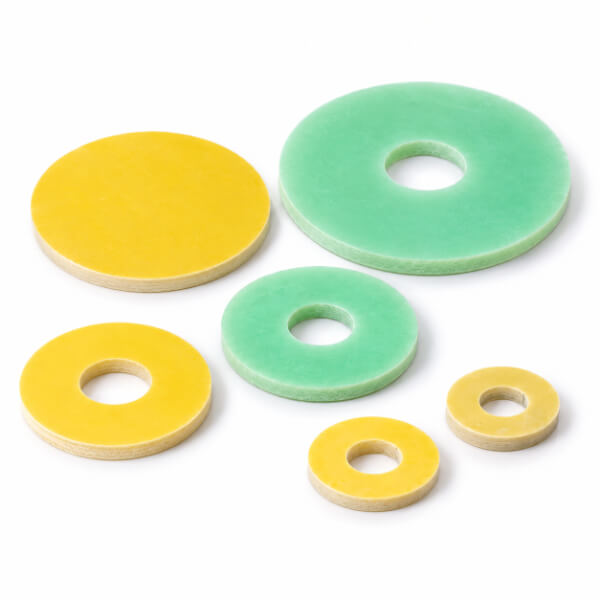
Selecting the part requires separating two ideas that are routinely confused. Clearance is the straight-line air gap between conductors — it resists a fast air breakdown from a voltage peak, and it is driven by peak voltage, overvoltage category and altitude. Creepage is the shortest path along the insulating surface — it resists slow surface tracking under sustained working voltage, and it is driven by RMS voltage, pollution degree and the material's comparative tracking index (CTI). IEC 60664-1 treats them as separate requirements, and satisfying one never satisfies the other.
The step matters because of the second path. A shoulder that stands proud of the mounting surface forces a surface-tracking path to travel down its side and around its base instead of crossing flat. That is real added creepage — if the geometry is designed for it. A shallow shoulder in a polluted compartment buys nothing, and a smooth flange pressed flat against a dirty metal plate can still track across its outer edge. Verify the finished geometry against the pollution degree and material group of the installation; a part number alone establishes no compliance.
Nylon shoulder washers are common in light electronics and are perfectly adequate there. They are cheap, easy to mould and electrically sound at low load. They fail quietly in the wrong application because of cold flow: under sustained bolt preload a thermoplastic slowly creeps, the joint relaxes, and the insulation thins exactly where the clamp force is highest. Epoxy-glass laminate is a thermoset. Its cross-linked resin and glass reinforcement resist compression and creep, so the clamp load stays where the assembler set it and the dielectric thickness stays intact.
Three properties make G10/FR4/G11 the serious choice for power hardware:
Compressive strength in the hundreds of MPa, so the flange does not crush under bolt tension the way a soft polymer washer can.
Low moisture uptake (typically well under 1% for electrical-grade epoxy glass), which keeps surface resistivity up in humid or outdoor service.
Dimensional stability across temperature, so the shoulder stays concentric around the shank and the hole clearance does not wander.
Against that, nylon wins on price and on parts that flex or snap together; epoxy glass wins where the bolt is torqued, the compartment is damp, or the voltage is high. The decision is a load-and-environment decision, not a catalogue preference.
All three sit in the same epoxy-glass family and share a glass-cloth reinforcement. They differ in flame behaviour and in how much strength they keep at temperature — two separate axes that the grade names encode.
| Grade | IEC family | Flame rating | Continuous duty | Where it fits | Watch-out |
| G10 | EP GC 201 | Typically UL 94 HB | ~130–155°C (Class B–F) | General baseline: enclosed, oil-filled or moderate-duty bolted insulation; best cost | Do not use where a V-0 flame rating is specified |
| FR4 | EP GC 202 | UL 94 V-0 | ~130–155°C | Open, dry-type or code-driven compartments that demand flame retardancy | V-0 does not raise the thermal ceiling |
| G11 | EP GC 203 | Typically HB (halogen-free variants available) | ~155–180°C (Class F–H) | Hot compartments; retains mechanical strength at temperature so the clamped flange does not relax | Not inherently V-0 — pair with enclosure barriers or move to FR5 where codes demand it |
| FR5 | EP GC 204 | UL 94 V-0 | ~155–180°C | The intersection: high temperature and flame rating together | Premium cost; specify only where both apply |
Two cautions follow directly. First, a request for "G10, V-0" is a contradiction: it describes FR4. Second, flame class and thermal class must be chosen independently: a hot, open compartment needs FR5, not G11 with a flame assumption written into the drawing. The same mapping (EP GC 201 = G10, 202 = FR4, 203 = G11, 204 = FR5) is used throughout this series, so a specification written here reads consistently against the tube and laminate articles.
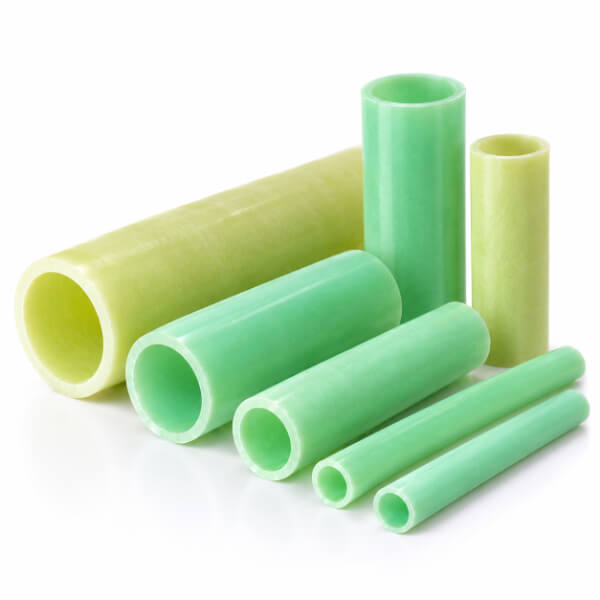
A plain insulating sleeve is the shoulder without the flange — a short tube of epoxy-glass fitted over a bolt, pin or conductor. It is the right part when the bolt head is already isolated by another means, or when a stack of collars must set a precise gap. In transformer core-clamping structures, for example, multiple thin sleeves are threaded onto a tie rod to hold cooling-duct spacing while keeping the steel clamping hardware electrically away from the core.
The design questions shift when you drop the flange:
Wall thickness becomes a dielectric variable. With no flange to extend the surface path, voltage from an energised bolt to the surrounding metal crosses the sleeve wall. Size the wall for that dielectric duty, not just for fit.
End faces become the weak point. A cut sleeve exposes glass fibre at both ends; those ends wick moisture and are the first place a tracking path starts. Seal them.
Fit needs thermal headroom. The sleeve must slip over the shank at assembly yet stay centred under vibration and expansion. A press fit that feels secure at room temperature can crack a laminate sleeve when the assembly warms.
A step washer solves the shank and the head together; a sleeve solves the shank alone and hands the head back to a separate washer. Neither is universally better — the choice is whether the joint has one insulation interface or two.
These parts are machined from sheet, rod or wound tube stock, and the machining changes the material locally. Three details decide whether a correctly graded part survives:
Give the shoulder root a radius. The junction between flange and shoulder is a stress concentration. Under clamp load and thermal cycling, a sharp internal corner is where a crack starts; a generous radius spreads the load into the flange.
Seal the machined edges. Cutting across the glass cloth exposes fibre ends and resin-rich edges. Left unsealed, they absorb moisture and lower the surface tracking resistance that the creepage calculation assumed. Seal with a compatible resin or coating after machining.
Control delamination at the flange. Epoxy glass is a laminate. Facing a thick flange or drilling a shoulder bore with a dull tool can lift the outer plies. Use sharp carbide or diamond tooling, support the part fully, and inspect the shoulder face before release.
These are not cosmetic finishes. A step washer's electrical performance is a property of the finished geometry, and a beautifully specified G11 blank can still be turned into a part that tracks early by a machined edge nobody sealed.
Consider a bolted busbar support in an outdoor, code-driven cabinet running warm. Work back from the demands: the joint is under sustained preload, so a thermoplastic shoulder washer is eliminated for cold flow; the cabinet is open to flame-code review, so G10 is out and the baseline becomes FR4; the compartment runs hot enough that FR4's strength retention is marginal, so step to FR5 for V-0 and the higher temperature family; the pollution level is industrial, so the flange diameter and shoulder height are set from creepage for the material group rather than copied from a catalogue drawing; the sleeve wall is sized for radial voltage with sealed end faces; and the shoulder root is radiused and all machined edges sealed. Every choice traces to a load, a path or a code — none came from reading the dielectric-strength column alone.
A step washer, often called a shoulder washer or shouldered insulating bushing, is a one-piece part with a flat flange and a cylindrical shoulder. The flange insulates the bolt head or nut from the surface it clamps; the shoulder sits inside the mounting hole and isolates the bolt shank from the hole wall. It replaces a separate flat washer plus sleeve with a single component, removing the interface where moisture and tracking can start.
Epoxy-glass laminate resists bolt clamp compression and creep far better than nylon, holds dielectric strength in humid service, and keeps its dimensions across temperature. Nylon is cheaper and fine for light electronic assemblies, but under sustained bolt preload it cold-flows, loosening the joint and thinning the insulation. G10 is the general baseline; FR4 adds UL 94 V-0 for flame-coded compartments; G11 retains mechanical strength at 155–180°C for hot gear.
It can, if the shoulder is designed for it. Creepage is the path along an insulating surface; clearance is the straight-line air gap, and the two are not interchangeable. A shoulder that stands proud of the mounting surface forces the leakage path to travel down and around it rather than straight across. To count that distance, the shoulder height and the surface continuity must be verified against the pollution degree and material group under IEC 60664-1 — a nominal part number does not establish compliance.
When the assembly falls under a flame-code requirement. G10 is typically UL 94 HB; FR4 is the brominated, UL 94 V-0 version of the same epoxy-glass family. For open, dry-type or code-driven switchgear, FR4 is the correct pick. Flame rating and thermal class are separate axes, so FR4 does not automatically raise the temperature ceiling — for a hot compartment that also needs V-0, specify FR5 rather than assuming FR4 covers both.
When the joint lives in a hot compartment. G10 (EP GC 201 family) is rated around 130–155°C; G11 (EP GC 203) is the high-temperature epoxy grade that retains a large fraction of its room-temperature flexural strength at 155–180°C. Under sustained bolt preload, that retained strength is what keeps the washer from relaxing and the flange from cracking at the shoulder — the failure mode that appears first in hot, clamped epoxy parts.
Check the grade and lot certification, not the colour. Then inspect the machined edges: the shoulder root is a stress concentration and exposed glass fibres there wick moisture, so edges should be sealed and the root given a generous radius. Confirm inner and outer diameters against the bolt and hole with clearance for thermal expansion, and verify the finished part's dielectric withstand — the grade is one input, the machining quality is the other.


