
Views: 0 Author: Fenhar Publish Time: 2026-07-16 Origin: Site


Epoxy glass cloth laminates — NEMA grades G-10, G-11, and FR-4 — share a common architecture: woven E-glass fabric layers bonded with epoxy resin under heat and pressure. This construction gives them a set of properties that few other materials can match simultaneously:
Dielectric strength from 40 kV/mm (FR-4) up to 50 kV/mm (G-11) — enough to insulate medium-voltage conductors with millimeters of material
Tensile strength at 300+ MPa — comparable to some aluminum alloys, with a density of only 2.0 g/cm³
Thermal endurance spanning Class B (130°C for G-10/FR-4) to Class F (155°C for G-11) — proven in continuous-duty transformer and motor environments
Near-zero moisture absorption — typically below 0.10%, meaning parts machined today will hold their dimensions and insulation values years from now in humid service
Chemical resistance to transformer oil, lubricants, weak acids, and common industrial solvents
What makes these laminates particularly suited for precision parts is their machinability. Despite the glass fiber content that demands carbide or diamond tooling, epoxy glass sheets CNC-machine to tight tolerances — typically ±0.05 mm on linear dimensions — and produce parts with clean edges when proper techniques are applied. The material's uniform internal structure (alternating glass plies and resin layers) means that a machined feature at any depth encounters predictable, consistent material behavior, not the random voids and density variations found in some mat-reinforced or cast alternatives.
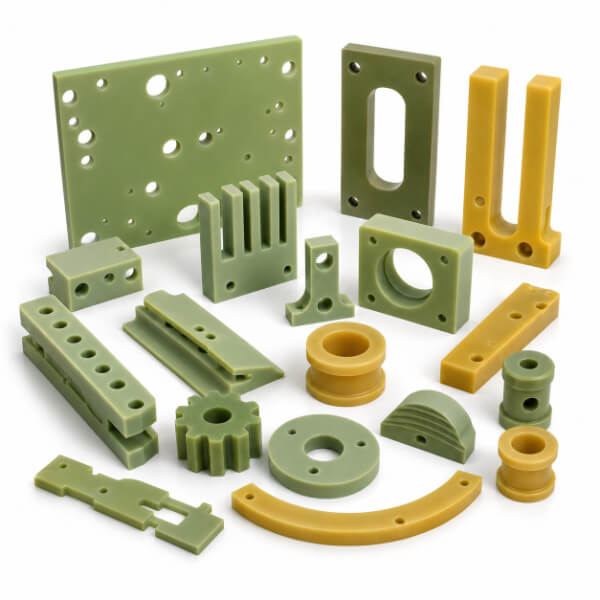
The most straightforward epoxy glass parts are also among the most widely produced: flat and tubular spacers that maintain a precise air gap or creepage distance between energized conductors and grounded structures. They appear in virtually every electrical assembly, from small control panels to large power transformers.
Flat washers and discs — punched or CNC-milled from sheet stock, used to insulate bolted busbar connections and mounting hardware. Thickness typically 0.5 mm to 6 mm; diameters from 6 mm to 150 mm.
Tubular standoffs (bushings) — turned from rod stock or machined from tube, providing both axial spacing and radial insulation around a fastener or conductor. Common in transformer tank wall penetrations and panel-mounted terminal blocks.
Stepped spacers — custom-profiled parts with different diameters at each end, allowing a single component to create both the mechanical clearance and the extended creepage path required by IEC 60664-1.
Stacked spacing collars — multiple thin sleeves assembled on a tie rod in transformer core clamping structures, maintaining precise duct dimensions for cooling oil flow while electrically isolating the clamping hardware from the core steel.
The engineering reasoning behind choosing epoxy glass for spacers is simple: in a high-voltage assembly, every fastener that passes through an energized conductor becomes a potential leakage path. A steel bolt carrying even a few milliamps of leakage current through a damp phenolic washer will eventually carbonize that washer's surface, converting an insulator into a conductor. Epoxy glass's combination of high dielectric strength and low moisture uptake prevents this cascade — and its compressive strength (350+ MPa) means the spacer won't crush under bolt tension the way softer polymer washers can.
For spacers operating in ambient conditions below 130°C, G-10 or FR-4 is sufficient. When a spacer sits adjacent to a heat source — a transformer winding hotspot, for example — G-11's Class F rating provides a necessary safety margin against long-term thermal aging.
Busbar systems — the backbone of power distribution in switchgear, motor control centers, and data center power infrastructure — rely on insulating supports that must simultaneously carry mechanical load and withstand electrical stress. Epoxy glass machined parts are the standard solution for three reasons: dimensional stability under clamping force, dielectric performance across the full voltage range, and resistance to the cumulative effects of thermal cycling.
Busbar mounting brackets — L-shaped, U-shaped, or custom-profiled supports CNC-milled from thick sheet stock (typically 6 mm to 25 mm). These brackets carry the busbar's weight and short-circuit electromagnetic forces while preventing contact with the grounded enclosure.
Insulating cleats and clamps — split or one-piece clamps that grip horizontal or vertical busbars and mount to the enclosure frame. Designed for specific busbar cross-sections, these are among the most common custom-machined epoxy glass parts.
Multi-layer terminal boards — thick laminated panels (often 10 mm to 30 mm) with drilled and tapped mounting holes for terminal studs, current transformers, and relay connections. The board's flat surface and drilled features replace what would otherwise require a metal panel plus separate insulators at every mounting point.
Phase separator barriers — vertical inserts between parallel busbars of different phases, increasing both the air gap and the creepage distance to prevent inter-phase flashover during a fault event. FR-4 is the preferred grade here because its UL 94 V-0 flame retardancy adds a critical safety margin.
Design Consideration: Busbar supports see both static loads (busbar weight plus bolt preload) and dynamic loads (short-circuit electromagnetic forces that can reach thousands of Newtons per meter of busbar). Epoxy glass's flexural strength (≥340 MPa perpendicular to laminations) handles both — but the part's geometry matters as much as the material. A well-designed busbar bracket distributes clamping force across multiple laminate plies rather than concentrating it at a single through-bolt hole, which can initiate inter-ply cracking under repeated load cycles.
Rotating machines and transformers contain some of the most geometrically complex epoxy glass parts in existence. Unlike flat spacers and simple brackets, these components must conform to the internal shapes of wound structures — stator slots, commutator profiles, winding ducts — while performing under continuous thermal, electrical, and mechanical stress.
Slot wedges — Laminated epoxy-fiberglass strips inserted into the open end of stator slots after winding, securing the coil against centrifugal and electromagnetic forces. Profiles include rounded noses for easy insertion, chamfers for varnish flow, and keyways for removal during rewind. Thickness range: 0.25 mm to 50 mm. Dielectric strength: ~450 V/mil. Fenhar manufactures these in standard and custom slot geometries matched to specific motor and generator designs.
Commutator reinforcing rings — Hoop-shaped epoxy-glass components fitted at the commutator base in DC motor assemblies. These rings hold the commutator stack's cylindrical shape under centrifugal loading at high rotational speeds, while maintaining electrical isolation between the commutator bars and the shaft. Typical flexural strength: 340 MPa. Service temperature: up to 130°C.
V-ring insulation — Conical insulating pieces that separate the commutator bars from the shaft at each end of the commutator assembly. Machined from epoxy glass sheet to match the commutator's inner diameter and angle.
Transformer winding spacers and duct strips — Thin rectangular strips placed between winding layers to create cooling oil ducts. These must maintain precise thickness (±0.05 mm) across hundreds of repeating positions to ensure uniform oil flow and consistent voltage distribution between layers.
Core clamping insulation plates — Flat plates at the top and bottom of transformer cores that insulate the steel core from the clamping frame. These plates carry the full compressive load of the core clamping bolts and must resist crushing without delaminating — a requirement that epoxy glass's 350+ MPa compressive strength addresses directly.
The slot wedge is a particularly instructive example because it illustrates how the part's geometry and the laminate's structure interact. A slot wedge is typically 1-3 mm thick — just a few glass cloth plies. When machined to its final profile, the cutting tool passes through the laminate at an angle, exposing both glass fiber ends and resin surfaces at the wedge's nose. The quality of that machined nose edge determines whether the wedge slides smoothly into the slot during assembly or gouges the winding insulation it's supposed to protect. This is why slot wedges require careful CNC finishing — the part's function depends on edge quality that only precision machining can deliver.
Grade Selection for Rotating Machine Parts: G-10 (Class B, 130°C) handles most motor and small transformer applications. For large power transformers with sustained winding hotspot temperatures above 130°C, and for motors in Class F insulation systems, G-11 (Class F, 155°C) is the correct specification. Using G-10 where G-11 is required doesn't cause immediate failure — but it reduces the insulation system's thermal life by roughly half for every 10°C overrun, per the Arrhenius thermal aging model that underpins IEC insulation class definitions.
Switchgear compartment insulation presents a dual challenge: the material must provide reliable electrical separation during normal operation, and it must resist degradation during fault events where arc temperatures can reach thousands of degrees. Epoxy glass occupies a specific position in this landscape — it's not the best arc-resistant material available (that distinction belongs to melamine glass grades G-5/G-9), but it serves a wide range of barrier and structural functions where arc resistance is one requirement among several.
Compartment barrier panels — Large flat sheets (often full-width of the switchgear cubicle) that separate functional units: busbar compartment, circuit breaker compartment, cable compartment. These panels must maintain dielectric integrity under normal voltage and provide at least initial arc resistance during the first seconds of a fault event before protection systems operate.
Insulating shutters and sliding barriers — Moving parts that cover live busbar stabs when a circuit breaker is withdrawn from its cubicle. These shutters must slide reliably under mechanical actuation, resist tracking from occasional flashover at the stab interface, and maintain flatness over years of operation. FR-4's flame retardancy is essential here.
Insulated operating rods and linkages — Long, slender machined components that transmit mechanical motion from the operator handle (at ground potential) to the circuit breaker mechanism (at line potential) through the insulating barrier. These rods must withstand the full phase-to-ground voltage continuously and the mechanical forces of breaker operation repeatedly — a combined electrical-mechanical load that few materials handle as well as epoxy glass.
Current transformer mounting frames — Custom-milled epoxy glass frames that hold CTs in position around the busbar, insulated from both the busbar and the enclosure.
For the barrier panels and shutters that define compartment boundaries, FR-4 is the default specification — its UL 94 V-0 flame retardancy is a regulatory requirement in most LV and MV switchgear standards (IEC 61439, UL 891). G-10 is sometimes used in enclosed, climate-controlled compartments where the flame-retardant requirement doesn't apply, but this is increasingly rare as standards tighten.
For the operating rod — the long insulating linkage — G-11 is the preferred grade when the switchgear operates at voltages above 1 kV, because its higher thermal class provides long-term stability against the cumulative effects of partial discharge and thermal cycling at the rod's high-voltage end.
In electronics manufacturing, epoxy glass sheet takes on a role that has nothing to do with insulation between power conductors — it becomes the structural backbone of production tooling. Wave solder pallets (also called solder carriers or solder templates) are board-specific fixtures that carry PCBs through the wave soldering machine, exposing only the areas that need solder while shielding everything else.
Wave solder pallets — Custom-milled from antistatic (ESD) epoxy glass sheet, each pallet is machined with cavities and openings that match a specific PCB layout. The pallet holds the board flat during the solder wave pass, shields SMD components from solder exposure, and provides handling features for the production line. Surface resistivity in the ESD range (10⁵–10⁹ Ω/sq) prevents static buildup without creating a conductive surface that could short PCB traces during handling.
Reflow solder carriers — Similar fixtures for reflow oven processing, designed to protect delicate components from direct thermal exposure while allowing the target solder joints to reach reflow temperature. Epoxy glass's low thermal conductivity (~0.25–0.30 W/(m·K)) helps maintain local thermal gradients on the pallet surface.
In-circuit test (ICT) fixtures — Flat epoxy glass plates with precision-drilled probe access holes, mounted in test equipment that contacts every test point on the PCB simultaneously. The material's dimensional stability ensures that probe holes don't drift over thousands of test cycles.
PCB drilling backup boards — Entry and exit boards placed above and below the PCB stack during CNC drilling. The epoxy glass entry board provides a clean, consistent surface for the drill bit's initial contact, reducing burr formation on the PCB's copper layers.
What makes the wave solder pallet application unique is the operating temperature. A pallet passes through a solder wave at 250–280°C — far above the thermal class rating of any standard epoxy glass laminate. This sounds like a contradiction, but it isn't: the exposure is brief (seconds per pass), and the pallet's epoxy formulation is specifically engineered for repeated thermal cycling at these peak temperatures without progressive degradation. Fenhar's ESD wave solder pallet material, for example, is rated for a maximum continuous operating temperature of approximately 280°C, with flexural strength of ~400 MPa retained through thousands of solder cycles.
Thin-Wall Feature Note: One of the most demanding machining requirements on a solder pallet is creating thin walls between adjacent PCB component cavities. Fenhar's woven laminate construction allows reliable thin-wall features down to approximately 0.50 mm — a dimension that would be impossible with mat-reinforced alternatives because their random fiber orientation creates unpredictable fracture paths at thin sections. The woven glass cloth's deliberate ply structure gives the thin wall a predictable, laminate-direction-controlled failure mode that engineering teams can design around.
Epoxy glass's mechanical strength profile — high compressive strength, good flexural modulus, and excellent dimensional stability — makes it viable for a range of mechanical parts that also happen to need electrical insulation or chemical resistance. In some cases, the insulation requirement is the primary driver; in others, it's the material's ability to run dry (without lubrication) in corrosive environments that makes it the choice.
Self-lubricating bearings — Filament-wound epoxy fiberglass bushes with a PTFE sliding layer, designed for dry-running joints in equipment where grease lubrication is impractical or prohibited (food processing, clean rooms, underwater systems). Fenhar's epoxy fiberglass self-lubricating bearings carry static loads up to 210 N/mm² and operate from –195°C to +160°C — a temperature range that covers everything from cryogenic pumps to furnace-adjacent machinery.
Bearing cages (retainers) — Ring-shaped components that separate rolling elements in a ball or roller bearing. When the bearing operates in an electrically sensitive environment (a motor's rotor bearing, for example), a conductive steel cage can allow shaft current to circulate through the bearing, causing electrical discharge machining (EDM) damage to the raceways. An epoxy glass cage eliminates this path entirely.
Custom gears and wear plates — G10 gears appear in light-load drive mechanisms where the gear must be non-conductive, chemically inert, or self-lubricating (when combined with PTFE overlays). These are niche applications compared to metal gearing, but they fill specific needs in instrumentation, food processing, and corrosive-environment machinery.
Wear rings and guide rings — Radial support components in pumps and compressors, where epoxy glass's resistance to hydraulic fluids, low water absorption, and dimensional stability under pressure loading make it an alternative to bronze or PTFE in specific designs.
The self-lubricating bearing is worth examining in detail because it represents a genuine engineering innovation rather than a simple material substitution. A traditional bronze bushing requires oil or grease — both of which contaminate the surrounding environment, require replenishment, and degrade at elevated temperatures. An epoxy fiberglass bearing with a PTFE running surface eliminates all three problems. The fiberglass-epoxy structural shell carries the load; the PTFE layer provides friction control; and the combination achieves a PV (pressure × velocity) factor of 1.23 N/mm²×m/s — sufficient for the slow-speed, high-load regime where these bearings are typically deployed.
Beyond the established categories above, epoxy glass sheet routinely gets machined into one-off and low-volume structural parts that don't fit any standard catalog — parts that exist because a specific design problem demanded a material that's simultaneously strong, insulating, stable, and machinable to tight tolerances.
Instrument housings and enclosures — Small CNC-milled boxes for electronic assemblies in measurement, control, and communication equipment, where the housing material must be both the structural shell and the electrical insulator.
Insulated hand tool inserts — Epoxy glass components embedded in the handles or jaws of insulated tools for live-line work, providing verified dielectric protection at specific voltage classes per IEC 60900.
Antenna and radome structural cores — Flat or shaped epoxy glass panels that serve as the mechanically rigid, electromagnetically transparent backbone of antenna structures, where the material's controlled dielectric constant (≤5.5) minimizes signal interference.
Battery pack insulation frames — In EV battery modules, epoxy glass frames separate and insulate individual cells, carrying both the structural load of cell clamping and the electrical isolation between adjacent cell groups. G-11's Class F thermal rating is increasingly specified here as battery pack operating temperatures rise above 130°C in fast-charging scenarios.
Cryogenic support structures — Epoxy glass maintains mechanical properties down to –196°C (liquid nitrogen), making CNC-machined supports viable for superconducting magnet structures, cryogenic fluid handling equipment, and space-qualification hardware where both insulation and structural integrity at extreme cold are non-negotiable.
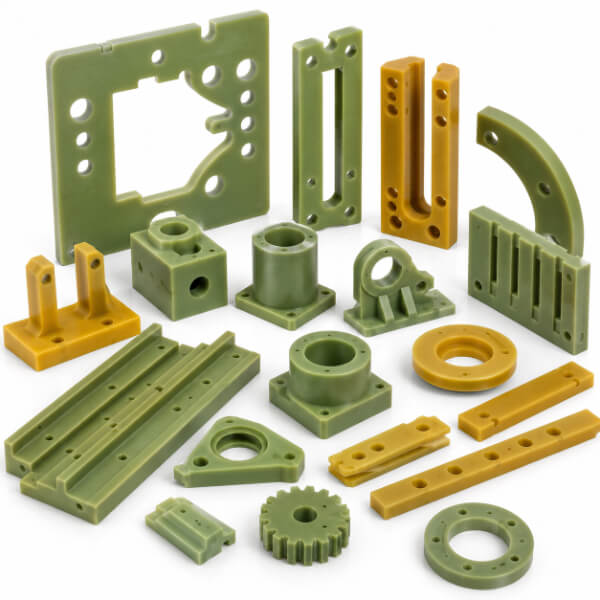
Having surveyed the part landscape, the practical question becomes: for a given component, which grade should the engineer specify? The decision matrix below synthesizes the reasoning from each category into a single reference.
| Part Type | Primary Grade | Why | Alternate Grade | When to Use Instead |
| Flat spacers, washers | G-10 / FR-4 | Class B sufficient; FR-4 if flame retardancy required | G-11 | Adjacent to heat source >130°C |
| Busbar brackets, cleats | FR-4 | UL 94 V-0 required by switchgear standards | G-10 | Enclosed, climate-controlled compartments only |
| Terminal boards | FR-4 | Flame retardancy mandatory per IEC 61439 | G-11 | High-temperature terminal compartments (above 130°C) |
| Slot wedges | G-10 | Class B standard for most motor insulation systems | G-11 | Class F motor insulation systems (155°C hotspot) |
| Commutator rings | G-10 | 130°C service temperature sufficient for most DC motor designs | G-11 | High-speed, high-temperature traction motor commutators |
| Transformer winding spacers | G-10 / FR-4 | Distribution transformers (Class B oil temperature) | G-11 | Power transformers with Class F insulation systems |
| Switchgear barrier panels | FR-4 | Flame retardancy non-negotiable in standard-compliant switchgear | G-11/FR-5 | MV switchgear with sustained high ambient temperatures |
| Operating rods (switchgear) | G-11 | Higher thermal headroom for long-term partial discharge resistance | G-10 | LV switchgear only (below 1 kV) |
| Wave solder pallets | ESD FR-4 variant | Antistatic surface + flame retardancy + thermal cycling resistance | — | Specialized material; no standard substitute |
| Self-lubricating bearings | Epoxy fiberglass + PTFE | Custom filament-wound construction; not cut from standard sheet | — | Requires dedicated manufacturing process |
| Battery pack insulation frames | G-11 | Class F thermal margin for fast-charging battery temperatures | FR-4 | Lower-temperature battery designs (<130°C) |
| Cryogenic supports | G-10 / G-11 | Both grades retain properties at –196°C; G-11 slightly better modulus retention | — | Grade matters less than part geometry and load path design at cryogenic temperatures |
A note on G-10 vs FR-4 interchangeability: In mechanical terms, G-10 and FR-4 are near-identical. The flame retardant additives in FR-4 (typically brominated compounds) marginally reduce some mechanical properties — flexural strength may be 2-5% lower — but this difference rarely affects part performance. What matters is the regulatory distinction: FR-4 is accepted everywhere G-10 is specified, but G-10 is not accepted where FR-4 is required by standard or code. When in doubt, specify FR-4 — it covers both scenarios.
After more than 20 years of machining epoxy glass components for clients across 16 industries, we've seen patterns in how parts succeed or fail in service. The following observations aren't found in material datasheets — they come from the accumulated experience of translating CAD drawings into functional, reliable components.
Many engineers specify the thickest available sheet for structural parts, assuming that more material means more strength. In epoxy glass laminates, this is not always true. The laminate's flexural strength perpendicular to the plies is excellent — but its interlaminar shear strength (the force required to separate one glass ply from the next) is fundamentally lower, typically 30-34 MPa. A thick part under through-thickness load can delaminate before it bends. For components that see significant interlaminar stress — clamped plates, bolted brackets, parts loaded across their thin dimension — the design should distribute load across the flat plane of the laminate rather than concentrating it through the thickness. This means wider bolt patterns, larger clamping surfaces, and fastener holes placed well away from edges where interlaminar stress concentrates.
A part's machined edges — the cut surfaces where the tool passes through the laminate — are its weakest points. At an edge, glass fiber ends are exposed, resin coverage may be interrupted, and the orderly ply structure transitions to a rough, heterogeneous zone where moisture ingress, chemical attack, and partial discharge all initiate preferentially. For parts that operate in humid, chemically exposed, or high-voltage environments, edge quality is more important than surface finish. Sharp, well-maintained carbide or diamond tooling produces edges with minimal fiber pull-out and resin smearing — and those edges will serve reliably for decades. Dull tooling creates edges that look acceptable on inspection but develop micro-cracks and fiber exposure that become failure initiation sites within months of service.
Epoxy glass laminate is not isotropic. Its properties differ depending on whether a load runs parallel to the glass cloth plies (within the plane of the sheet) or perpendicular to them (through the thickness). Tensile strength in-plane exceeds 300 MPa; interlaminar shear is only 30-34 MPa. This means that a long, narrow bracket machined with its length running along the sheet surface will be significantly stronger than the same bracket machined with its length running through the sheet thickness. Whenever possible, orient the part's primary load path in the plane of the laminate. When a through-thickness load is unavoidable (a bolt clamping force, for example), design the clamping area to be as wide as possible relative to the part's thickness to keep interlaminar stress below critical levels.
Epoxy glass can be CNC-machined to ±0.05 mm on linear dimensions — but that precision costs money in tooling time, inspection, and scrap. Not every part needs it. A busbar spacer that creates 12 mm of creepage distance doesn't need ±0.05 mm tolerance; ±0.15 mm is more than adequate and reduces machining cost significantly. A slot wedge that must fit into a 2.5 mm slot, however, requires ±0.05 mm because a wedge that's too thin will vibrate under electromagnetic force, and one that's too thick won't insert without damaging the winding. Match tolerance investment to functional consequence — and your production cost will drop without affecting part reliability.
Fenhar manufactures G-10, G-11, and FR-4 epoxy glass sheets in standard and custom dimensions, and provides CNC machining services for finished insulation parts — from simple spacers to complex slot wedges, commutator rings, and ESD solder pallets. Our engineering team can help you select the right grade, define tolerances, and optimize part geometry for reliable performance.
The range of parts that can be machined from G-10, G-11, and FR-4 epoxy glass sheets is broader than the standard narrative suggests. These materials don't just make flat washers and simple spacers — they produce the precision components that hold transformers together, keep motors running, protect switchgear compartments, carry PCBs through solder waves, and bear mechanical loads without lubrication in corrosive environments.
Each part type carries specific engineering logic: why epoxy glass is chosen, which grade fits the thermal and regulatory requirements, and how the part's geometry interacts with the laminate's directional structure. Understanding that logic — rather than treating G-10/FR-4 as interchangeable, generic "insulation material" — is what separates a well-designed epoxy glass component from one that passes incoming inspection but accumulates hidden weaknesses over years of service.


