
Views: 0 Author: Site Editor Publish Time: 2026-03-25 Origin: Site


When most people think of high-performance drones, their minds immediately jump to carbon fiber. And for good reason—carbon fiber is the darling of aerospace, offering incredible stiffness for its weight. But if you look closely at the commercial and industrial drone market, you’ll notice a different story playing out.
The vast majority of UAVs flying today—from agricultural sprayers to delivery drones—aren’t built from a single wonder material. Instead, they rely on a sophisticated blend of materials: aerospace-grade aluminum for motor mounts, high-performance plastics for housings, carbon fiber for primary load-bearing spars, and, most critically, Glass Fiber Reinforced Plastic (GFRP) for everything else.
At its core, drone engineering is a constant battle against gravity. Every gram saved translates directly to longer flight times and higher payload capacity. But there’s a fine line between "light" and "flimsy." This is where GFRP has carved out its irreplaceable niche.
While carbon fiber often takes the spotlight for the main skeleton, GFRP serves as the connective tissue—the parts that must withstand constant vibration, endure repeated impact, and maintain structural integrity without breaking the bank.
For manufacturers looking to scale production or design UAVs that can survive the rigors of the real world, GFRP isn’t just an alternative; it’s often the superior choice for specific, high-stress components.
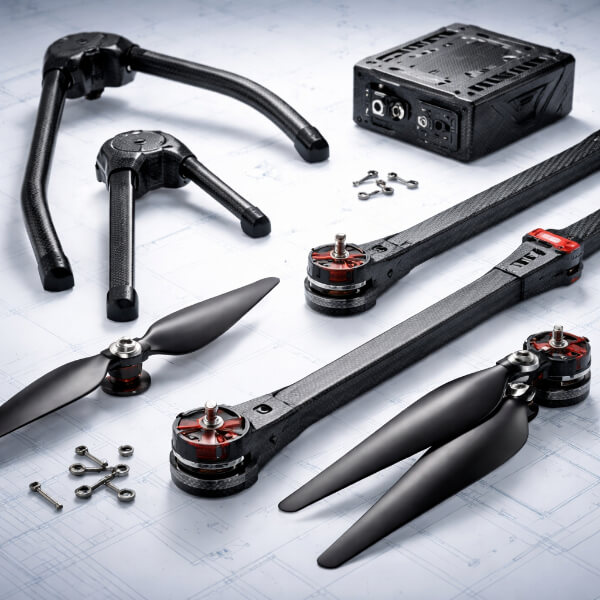
To understand where GFRP fits, it helps to look at the drone as a system. A typical UAV utilizes a hybrid material strategy:
Carbon Fiber Reinforced Plastic (CFRP): Reserved for the main wing spars, central fuselage keels, and high-end propeller blades where maximum stiffness is non-negotiable.
Aluminum Alloys: Used for high-heat areas like motor bases or critical structural joints where thermal stability and absolute strength are required.
Thermoplastics (ABS, Polycarbonate): Found in non-structural battery covers and decorative shells where aesthetics and low cost are the priority.
GFRP (Glass Fiber Reinforced Plastic): Positioned squarely in the middle. It occupies the "Goldilocks" zone where components need to be lighter than metal, tougher than standard plastic, and more cost-effective than carbon fiber.
As a GFRP manufacturer, you know the material’s tensile strength and corrosion resistance on paper. But how do engineers actually apply it in the field? Here are the specific components where GFRP is currently the material of choice.
In multi-rotor drones, the arms are the primary link between the motors and the main body. They endure constant bending moments from thrust, high-frequency vibration, and occasional hard landings.
Why GFRP wins: Tubular GFRP arms (often pultruded) offer an excellent balance of flexural rigidity and impact resistance. Unlike carbon fiber, which can shatter under sudden shock, GFRP tends to flex or splinter rather than catastrophically fail. This makes it ideal for industrial drones that operate in unpredictable environments. It also dampens vibration better than aluminum, leading to cleaner sensor data.
Landing gear is a sacrificial component. It takes the full brunt of the landing impact, dragging forces, and ground debris.
Why GFRP wins: Skids and struts made from GFRP act like leaf springs. They absorb energy efficiently and return to shape. While metal landing gear can bend permanently (requiring replacement) and carbon fiber can crack under point stress, GFRP offers a "forgiving" strength. It’s tough, corrosion-resistant against wet grass or saltwater, and significantly lighter than aluminum skids.
This is perhaps the most common application, yet it’s frequently misunderstood. While high-end racing drones often demand the razor-edge stiffness of carbon fiber, the vast majority of industrial propellers are molded from glass-filled nylon (a form of GFRP).
Why GFRP wins: A propeller must maintain its aerodynamic profile under extreme centrifugal force. GFRP provides the necessary rigidity to prevent blade flapping at high RPMs. More importantly, it offers fatigue resistance. A carbon blade that nicks a small rock is often compromised; a GFRP blade can absorb that minor impact without internal delamination, making it the safer, more durable choice for long-duration commercial flights.
In fixed-wing drones, the fuselage is often split into "wet areas" (primary structure) and "dry areas" (payload bays).
Why GFRP wins: You will rarely find carbon fiber used for a battery hatch or an electronics bay cover. These areas require moderate strength but also something carbon fiber struggles with: radio transparency. GFRP is transparent to electromagnetic waves. Using GFRP for nose cones, wing tips, and equipment bay covers ensures that GPS antennas, telemetry radios, and LiDAR sensors operate without signal interference—a critical factor often overlooked in structural design.
These are the "local stress" points. The motor mount must handle torque and heat, while the avionics enclosure must protect sensitive circuit boards from vibration.
Why GFRP wins: For motor mounts, GFRP composites can be compression-molded into complex shapes that fit specific motor patterns, offering thermal stability superior to standard plastics. For avionics, the material’s inherent dielectric properties prevent short circuits and electromagnetic interference, ensuring the flight controller operates in a "clean" environment.
Beyond injection-molded compounds, a separate category of glass fiber reinforced plastics—woven glass fabric laminated with epoxy or other thermoset resins—plays a critical role in drone manufacturing, especially for structural panels, mounting plates, and electrical insulation components. Among these, four standardized grades stand out as industry benchmarks.
G10
The most widely recognized glass epoxy laminate. G10 offers high mechanical strength, excellent dimensional stability, and low moisture absorption. In UAV applications, it is commonly machined into motor mounting plates, flight controller platforms, and battery isolation panels where flatness and consistent thickness are essential.
G11
A close relative of G10 but engineered for elevated temperatures. G11 retains its mechanical properties at higher operating temperatures and offers superior creep resistance under continuous load. This makes it the preferred choice for structural brackets near propulsion systems or avionics components that generate sustained heat.
G15
Less common than G10 but highly specialized. G15 is a glass fabric reinforced with melamine resin, offering excellent arc resistance and self-extinguishing properties. It is typically specified for high-voltage insulation applications within drone power distribution boards or battery management systems where electrical safety is paramount.
FR-4
The most widely adopted flame-retardant glass epoxy laminate in the electronics industry. While FR-4 is best known as the standard material for printed circuit boards (PCBs), its flame rating (UL94 V-0), combined with good mechanical strength and dielectric properties, also makes it suitable for non-PCB structural components such as electronics enclosure partitions, terminal blocks, and custom insulating brackets inside UAV fuselages.
Each of these grades is typically supplied as flat sheets or panels and can be CNC-machined into precision components. For drone manufacturers, the choice between them usually comes down to three factors: thermal exposure, electrical requirements, and flame-retardancy standards.
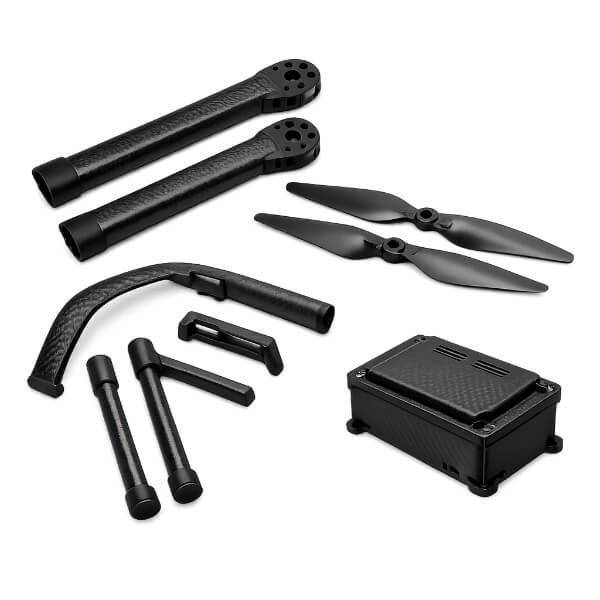
For drone OEMs (Original Equipment Manufacturers), the engineering challenge is always balancing the Bill of Materials (BOM) against performance.
Cost vs. Performance: Carbon fiber raw materials and autoclave curing are expensive. GFRP can be injection molded or compression molded at a fraction of the cycle time and cost.
Corrosion Resistance: Unlike aluminum, GFRP doesn’t corrode when exposed to agricultural chemicals (fertilizers, pesticides) or saltwater, which is a massive selling point for the agricultural and maritime drone sectors.
Safety: In a crash, carbon fiber components can shatter into sharp, conductive shards that may short-circuit flight batteries. GFRP components are less conductive and tend to fail in a less catastrophic manner, improving post-crash safety.
If you are sourcing materials for drone manufacturing, it is tempting to spec carbon fiber for every component to market the UAV as "high-end." However, experienced structural engineers know that over-specifying leads to unnecessary cost and brittle failure points.
Glass Fiber Reinforced Plastic is not a "cheap alternative" to carbon fiber; it is the strategic alternative. It is the material that allows drones to land hard, fly in corrosive environments, maintain clear radio signals, and remain economically viable for mass production.
For manufacturers looking to optimize their UAV platforms—whether fixed-wing, multi-rotor, or VTOL—the smart play is not choosing one material over the other. It is knowing exactly where to deploy GFRP to maximize durability, functionality, and return on investment.


