
Views: 0 Author: Fenhar Publish Time: 2026-10-19 Origin: Site


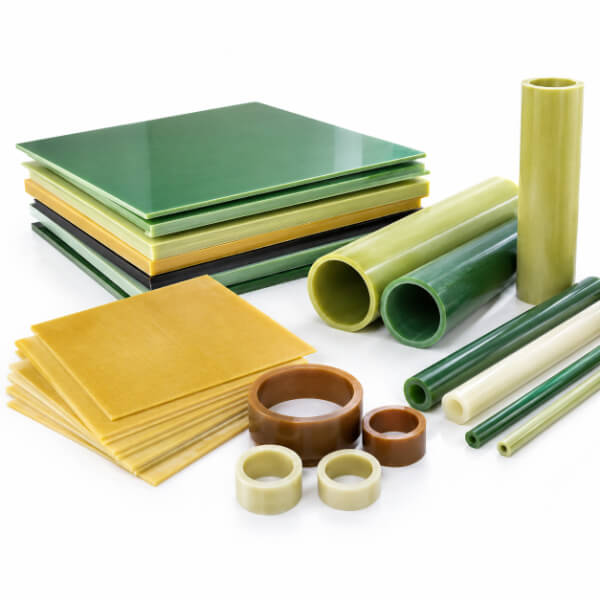
The first clarification is that both families are built from continuous woven E-glass fabric. The reinforcement is the same; what separates them is the thermosetting binder impregnated into that glass. An epoxy-glass laminate bonds the cloth with epoxy resin; a polyimide-glass laminate bonds it with polyimide. Because the visible result—colour, weave, stiffness—is so similar, the only reliable way to tell them apart is the resin line on the data sheet.
The standards reflect this cleanly. Epoxy-glass maps to the IEC EP GC family (EPGC 201/202/203/204; DIN equivalent HGW 2372) (G-10, FR-4, G-11, FR-5 in NEMA); polyimide-glass maps to IEC PIGC 301 (NEMA G-15). If a grade's certification carries a PIGC number, the resin is polyimide regardless of what the product name says—a point worth remembering, because supplier labels are not always consistent.
This is where the two resins part company. Epoxy begins to lose interlaminar shear strength and soften as it approaches its glass-transition region. Standard epoxy-glass sits at a Tg of roughly 130–140°C (high-Tg FR-4 and G-11 reach about 170°C), and continuous service is realistically 130–155°C. Push past that and an epoxy part creeps, loses clamp load, or delaminates.
Polyimide's aromatic, ring-locked structure stays cross-linked and dimensionally stable far higher. A glass-polyimide laminate carries a Tg of roughly 200–300°C and a continuous-service rating of 200–260°C. It retains useful flexural and dielectric strength past the point where epoxy has already failed. If your service temperature sits at or above 200°C, epoxy is off the table and polyimide is the standard answer.
Beyond heat, polyimide's other defining trait is very low outgassing. Grades in this family meet low-contamination specifications such as ASTM E595, releasing negligible volatile material in vacuum. Epoxy laminates outgas more and are not qualified for those duties.
That single property is what puts polyimide—not epoxy—inside semiconductor vacuum chambers, plasma tools, satellites, and spacecraft interiors, where outgassed organics would fog optics or contaminate sensors. If the requirement mentions vacuum, outgassing limits, or a space-rated environment, the choice is effectively made for you.
Both materials are strong electrical insulators, but polyimide sits a notch above on the numbers that matter at temperature:
Dielectric strength: epoxy-glass typically tests around 400–500 V/mil; glass-polyimide commonly reaches 700–850 V/mil.
Flexural strength: epoxy-glass floors at about 55,000 psi (typ. 60–70 ksi); glass-polyimide exceeds 78,000 psi (≈540 MPa).
Flame: FR-4 is UL 94 V-0 by design; non-FR epoxy grades (G-10) are only HB. Polyimide laminates are typically V-0 as well, so neither gives up fire safety.
At room temperature the two are close enough that epoxy wins on cost. The gap opens only when heat, load at heat, or outgassing enters the equation.
Epoxy-glass is genuinely good on moisture and everyday chemicals—low water absorption and resistance to oils, solvents, and mild acids or alkalis, which is why it dominates general insulation. Polyimide matches that chemical inertness and adds two things epoxy lacks: strong radiation resistance and stable performance in hard vacuum. For nuclear-adjacent, aerospace, or space hardware, that extra margin is decisive.
Epoxy-glass is a commodity. Grades like G-10, FR-4, and G-11 are stocked worldwide, inexpensive, and machined with standard carbide tooling. Polyimide is a premium, specialized grade carried by fewer suppliers; expect higher material cost and lead time, and treat the glass abrasion with sharp tooling and good dust extraction. The trade is that polyimide machines cleanly (it does not melt or gum) and holds tight tolerances—so the higher price buys both performance and precision.
| Attribute | Epoxy-glass (G-10 / FR-4 / G-11) | Polyimide-glass (NEMA G-15 / PIGC 301) |
| Reinforcement | Woven E-glass fabric | Woven E-glass fabric |
| Resin | Epoxy (brominated for FR-4) | Polyimide |
| Glass-transition (Tg) | ~130–170°C | ~200–300°C |
| Continuous service | ~130–155°C | ~200–260°C |
| Outgassing (ASTM E595) | Moderate | Very low (NASA-grade) |
| Flexural strength | ≥55,000 psi (typ. 60–70 ksi) | >78,000 psi (≈540 MPa) |
| Dielectric strength | ~400–500 V/mil | ~700–850 V/mil |
| Flame class | V-0 (FR-4); HB (G-10) | V-0 (typical) |
| Cost / availability | Low cost, ubiquitous stock | Premium, limited stock |
| Best for | General insulation & support to 155°C | Heat + vacuum + structural load at temperature |
Use this as a fast filter before opening a data sheet:
Choose epoxy-glass (G-10, FR-4, or G-11) when service stays at or below ~155°C, there is no vacuum or outgassing limit, and cost or same-week availability matters. For flame compliance pick FR-4; for maximum non-FR strength pick G-10; for the highest epoxy temperature band pick G-11.
Choose polyimide-glass when service reaches 200°C or higher, a vacuum or low-outgassing requirement is present, or the part must carry structural load while soaked in heat. This is the only standard laminate family that covers that envelope without a custom compound.
For the 155–200°C gap, high-Tg epoxy (G-11, FR-5) is the cheaper bridge; only step up to polyimide if you cross 200°C or hit an outgassing limit.
The cost of a wrong choice is rarely immediate—it surfaces in service, which is the worst place to discover it. Recognizing the failure signature lets you catch a mis-specification on paper:
Epoxy pushed past its ceiling: the laminate creeps under bolt clamp load, so insulators loosen and busbar supports lose rigidity. In a sealed enclosure, softened epoxy can cold-flow into air gaps and establish a tracking path. The part does not shatter; it quietly surrenders its clearance.
Epoxy in vacuum: outgassed plasticizers and residual cure volatiles condense on the nearest cold surface—optics, contacts, sensor windows—causing drift or contamination that no in-chamber cleaning can fully reverse.
Polyimide under-specified: this one does not fail mechanically at low temperature; it fails economically. You pay three to five times the material cost and accept a longer lead time for capability the application never exercises. The remedy is a re-specification, not a replacement.
The stock-substitution trap: reaching for "a green G-10-looking sheet" because polyimide is out of stock, then fitting it where 200°C rules apply. The sheet looks right on the bench and fails in the first thermal cycle.
None of these are exotic. They are the routine ways a resin mismatch becomes a field return, and every one is preventable at the data-sheet stage.
One caution closes the loop: a grade letter or a supplier's marketing name is not proof of resin. Always read the resin system and the IEC/NEMA designation on the certification—epoxy maps to the IEC EP GC family (EPGC 201/202/203/204; DIN equivalent HGW 2372), polyimide to IEC PIGC 301. We have seen a high-temperature grade marketed under a name that implied epoxy while its own IEC code declared polyimide; the code was right. When the heat, vacuum, or budget stakes are real, the certification—not the catalogue headline—is what you specify against.
No. Epoxy and polyimide are entirely different resin chemistries. Epoxy is a two-part thermoset cured by cross-linking; polyimide forms through an imidization reaction that builds dense aromatic ring structures. Those rings resist thermal degradation far beyond what any epoxy can tolerate, which is why polyimide laminates hold their strength and dielectric properties at temperatures that make epoxy soften and creep. They are not grades of the same material.
Not as a standard duty. Epoxy-glass grades such as G-10, FR-4, and G-11 are specified for continuous service around 130–155°C; above that they lose interlaminar strength and begin to soften. High-Tg epoxy formulations (G-11, FR-5) push toward 170–180°C but still fall short of 200°C continuous. If the service temperature sits at or above 200°C, a polyimide laminate is the correct standard choice.
Polyimide. It meets low-outgassing specifications such as ASTM E595, so it does not shed volatile contaminants inside vacuum chambers, plasma tools, or spacecraft where fogged optics or sensors would be unacceptable. Epoxy laminates outgas more and are not qualified for those environments. Choose polyimide wherever vacuum or outgassing limits are part of the requirement.
Epoxy-glass is far cheaper and easier to source. Grades like G-10, FR-4, and G-11 are commodity materials stocked by many fabricators worldwide and simple to machine with standard tooling. Polyimide laminates are a premium, specialized grade carried by fewer suppliers, so plan lead time and expect a higher material cost—justified only when heat, vacuum, or structural load at temperature demands it.
Yes—both families are built from continuous woven E-glass fabric. The reinforcement is the same; the resin binder is what separates them. That is exactly why they look identical on a shelf and why the resin line on the data sheet, not the colour or weave, is the property that decides the specification.
Read the resin line and the IEC or NEMA designation on the certification, not the marketing name. Epoxy-glass maps to the IEC EP GC family (EPGC 201/202/203/204; DIN equivalent HGW 2372); polyimide-glass maps to IEC PIGC 301 (NEMA G-15). A grade letter or a supplier's casual label can be unreliable—verify the resin system on the lot certification before you quote or substitute, because epoxy and polyimide are not interchangeable.


