
Views: 0 Author: Fenhar Publish Time: 2026-09-18 Origin: Site


Type "insulation class" into any search engine and you will meet the same table within three clicks: Class A is 105°C, B is 130°C, F is 155°C, H is 180°C, and on to 220°C (Class R — the temperature legacy motor literature labels "Class C") and beyond. It is correct, it is everywhere, and it is where almost all of the useful explanation stops. The table tells you the labels. It does not tell you what the labels are allowed to promise — and that gap is where equipment is quietly under-specified, over-heated, and retired early.
This article works the other direction. It starts from what a thermal class actually is — a half-life temperature derived from an endurance test, not a material melting point — then explains the two rules that decide whether your nameplate class is real, the three-term budget that eats most of the margin in practice, and finally what happens when the class system meets the laminate grades engineers actually specify (G10, FR4, G11, G7). The goal is not to memorize the table but to know what you are allowed to believe when you read it.
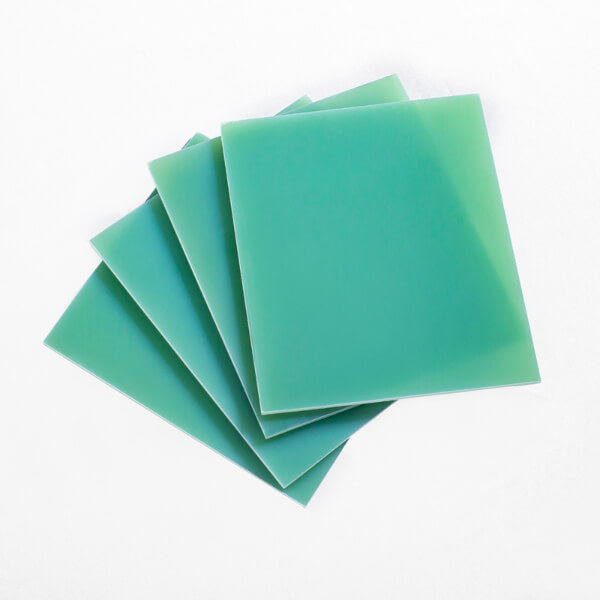
IEC 60085 defines the thermal classes as a ladder of maximum continuous temperatures. The NEMA letter designations map onto the same numbers exactly, so a "Class F" in North America is the same 155°C as "Class 155" elsewhere. Here is the ladder as it is normally drawn:
| Thermal Class | Letter | Max Continuous Temp | Typical Material Families |
| 90 | Y | 90°C | Untreated paper, silk, cotton, vulcanized rubber |
| 105 | A | 105°C | Impregnated paper, cotton, some synthetic fibers |
| 120 | E | 120°C | Polyurethane, polyethylene terephthalate films |
| 130 | B | 130°C | Mica, glass, asbestos with organic binders; epoxy-glass (G10/FR4) |
| 155 | F | 155°C | Class B materials with stable binders; high-Tg epoxy-glass (G11/FR5) |
| 180 | H | 180°C | Silicone elastomers; inorganic materials with high-temp binders; silicone-glass (G7) |
| 200 | N | 200°C | Class B families plus PTFE (Teflon) |
| 220 | R | 220°C | Polyimide films and enamels |
| 250 | — | 250°C | Polyimide, ceramic-filled, and other high-temperature families |
| 275+ | — | 275°C and above | No letter assigned; classes above 250°C step up in 25°C increments (275, 300, 325…) |
The line almost nobody quotes is the one underneath the table: the class is a maximum continuous temperature for an economically defined service life, and the bands are asymmetric. A material whose measured endurance reaches 154°C is Class 130 — you always round down to the threshold, never up. That single rule explains more specification disputes than the whole ladder.
The number 155 in "Class 155 (F)" is shorthand for a measured value called the temperature index (TI). The TI is the temperature at which the material, after a defined long-term thermal exposure, still retains about half of a critical property — dielectric strength, or tensile strength — compared with its unaged value. The conventional exposure horizon is 20,000 hours, a little over two years of continuous operation accelerated and extrapolated from Arrhenius aging data.
Two consequences follow that most pages skip. First, the class is assigned by rounding the TI down to the nearest band. A laminate whose TI measures 152°C is Class 130 (B), not Class 155 (F), even though it sits only 3°C below the F threshold. The band edge is a hard floor, not a target you can nudge. Second, the TI is a property of one critical attribute — and materials can have more than one. Under UL 746B the same idea appears as the relative thermal index (RTI), reported separately as RTI Elec (dielectric strength retained), RTI Str (tensile strength retained), and RTI Imp (impact strength retained). A part can be Class F on its electrical RTI and only Class B on its mechanical RTI; the weaker of the two governs how you may use it.
This is also where a dangerous piece of marketing language lives. "Continuous operating temperature" has no single standardized test behind it. One supplier's 150°C continuous rating may be a TI-style endurance figure; another's may be a short-term heat-deflection number with a completely different meaning. When a laminate or wire data sheet offers only "continuous operating temperature" with no named standard (IEC 60216, IEC 60085, or UL 746B), treat the number as unverified until the test method is named.
The second misconception is subtler and causes real field failures: the thermal class printed on a motor or transformer nameplate belongs to the insulation system (EIS), not to any individual material in it. IEC 60085 draws a hard line between an electrical insulating material (EIM) — a wire enamel, a film, a varnish — and the complete insulation system those materials form together with the conductors they touch. The standard is explicit that you may not infer a material's endurance from the system's class, or vice versa.
Practically, this means the system class is set by its thermally weakest component. A winding built from Class H wire enamel, Class H slot liner, and Class H sleeve can still be a Class F — or worse — system if the impregnating varnish breaks down at 155°C, or if two components interact badly. Chemical incompatibility (one binder plasticizing another) or mismatched thermal expansion can drag the whole system below the endurance of its best part. The reverse is also true and is why the rule is not simply "use the lowest label": a protective varnish that seals a wire enamel from oxygen can let that enamel survive in a hotter system than its standalone rating suggests. The system class is an emergent property, not a sum.
Specify the system, verify the components. In a rewind or a custom coil, mixing "equivalent class" materials from different suppliers, or short-changing varnish impregnation, can silently downgrade the effective class even when every component label reads correctly.
Watch the binder, not just the backbone. Mica and glass cloth survive at temperatures far above their class; the organic binder holding them is usually the part that ages. A "mica-based Class H" tape is only as good as its resin.
Remember the five stresses multiply. Thermal aging rarely acts alone. Heat plus vibration plus moisture degrades faster than the temperature trend on a monitor implies — which is why hot-spot margin, not just the class, earns its keep.
Even when the system class is honest, most of the margin is consumed by a budget most people never write out. The maximum internal winding temperature is:
Twinding = Tambient + ΔTrise + Thot-spot
NEMA MG 1 sets the reference ambient at 40°C. The temperature rise is the allowed increase above that ambient at full load, and it depends on cooling class and service factor. The hot-spot allowance (typically 5–15°C) covers the fact that the inside of a coil runs hotter than its average, measurable by resistance. The sum must not exceed the class limit.
| Class | Max Hot-Spot (°C) | Allowed Rise, 1.0 SF (K) | Allowed Rise, 1.15 SF (K) |
| A | 105 | 60 | 70 |
| B | 130 | 80 | 90 |
| F | 155 | 105 | 115 |
| H | 180 | 125 | — |
Two things fall out of this table that engineers exploit constantly. First, a Class F motor at 1.0 service factor is allowed a 105 K rise plus roughly 10 K hot-spot, reaching 155°C only at full load in a 40°C room — but designers routinely build it with a Class B (80 K) rise. That "F/B" notation — Class F insulation, Class B temperature rise — is not a contradiction; it is a deliberate 25°C margin that, by the 10°C rule, multiplies expected life several times over. Running cooler than the class is the normal, life-extending choice. Second, the budget is ruthless about ambient: a motor rated for a 40°C room that is installed in a 50°C enclosure has already spent 10 K of margin before it carries a single amp. The class did not change; the budget did.
A small but persistent confusion is which part of "Class 155 (F)" carries the meaning. It is the number. The letter (Y, A, E, B, F, H, N, R) is an optional shorthand that IEC permits "where space is limited," such as a nameplate. Writing "Class F rated 155°C" has the relationship backwards; the correct form is "155°C insulation, optionally tagged F." Above Class 250 the standard assigns no letters at all — classes continue at 25°C increments (275, 300, …) as bare numbers, which is the quiet tell that the letters were never the point.
The practical upshot: when comparing two insulations, compare the numbers, and watch the asymmetric rounding. A supplier who advertises "up to 154°C" material is selling you Class 130 (B) by the book, even though the number sits three degrees under the F line. The class band is a floor you round down to, and the letter is the least informative thing on the label.
For engineers who specify rigid laminated insulation — slot wedges, phase barriers, transformer spacers, busbar supports — the thermal class collides with a different labeling system: the NEMA grade (G10, FR4, G11, G7). The two systems describe the same underlying chemistry but are easy to confuse, and the confusion produces exactly the silent downgrades described above. The mapping, stated plainly:
| NEMA Grade | Resin / Note | Thermal Class | Where It Earns Its Keep |
| G10 / FR4 | Standard epoxy; FR4 adds brominated flame retardant (UL 94 V-0) | Class B — 130°C | Terminal boards, panels, PCB substrates, ambient-to-moderate structural insulation |
| G11 (EPGC 203) | Higher-Tg epoxy; retains strength above 130°C | Class F — 155°C | Transformer spacers, motor slot wedges, hot switchgear phase barriers |
| FR5 | G11-class epoxy + UL 94 V-0 | Class F — 155°C | Where both Class F thermal and fire-rating compliance are required together |
| G7 | Silicone-glass; trades mechanical strength for heat | Class H — 180°C | High-temp motor insulation, traction components, furnace-area equipment |
| G9 | Melamine-glass; arc-resistant | ~Class B/E, arc-focused | Arcing contact areas, switchgear where arc resistance is the primary requirement |
Two specification traps sit inside this table. The first is the most repeated error in laminate procurement: FR4 is a flame-retardant grade, not a thermal class. FR4 carries the same Class B (130°C) rating as plain G10 — the bromine only changes fire behavior, not endurance. Specifying FR4 for a barrier that must survive 155°C continuous is a mistake; the correct call is G11 or FR5 (Class F). The second trap is the cost-driven downgrade: substituting G10 or FR4 into a G11-specified slot wedge or spacer, to save on material, lets the part soften and creep exactly where the winding depends on its dimensional stability. Grade exists because the cheaper grade fails at that temperature — never downgrade to cut cost in a high-heat location.
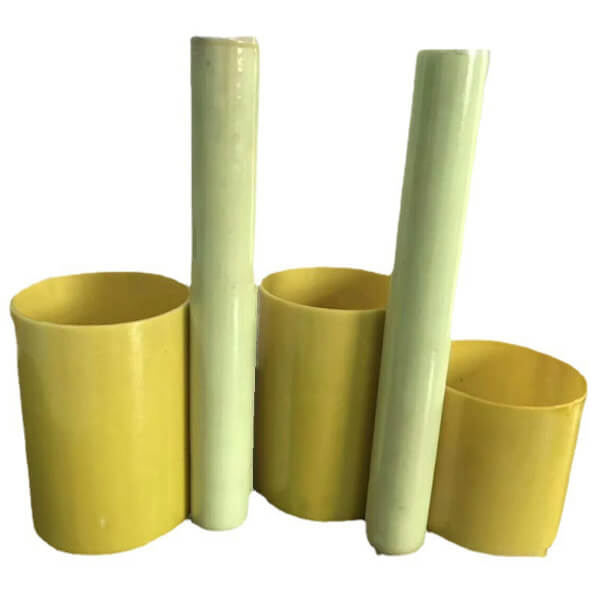
The thermal class is the rounded label on the nameplate — a band such as 155 (F) or 180 (H). The temperature index (TI) is the underlying measurement: the temperature at which the material retains about half of a critical property (dielectric strength, tensile strength) after a defined long-term exposure, conventionally 20,000 hours. The class is assigned by rounding the TI down to the nearest band threshold — a material with a TI of 154°C is Class 130, never Class 155. So the class is a coarse public promise derived from a precise endurance test, not the other way around.
Because the nameplate class is a ceiling, not a target. The actual winding temperature is ambient (40°C reference) plus the temperature rise permitted by NEMA MG 1 plus a hot-spot allowance. A Class F (155°C) motor at 1.0 service factor is allowed a 105 K rise plus roughly 10 K hot-spot, landing at about 155°C only at full load in a 40°C ambient. Designers routinely pair Class F insulation with a Class B (80 K) rise — the "F/B" motor — leaving a 25°C margin that, by the 10°C rule, multiplies expected life several times over. Running cooler than the class is the normal, life-extending choice, not an error.
No — FR4 is a flame-retardant grade, not a thermal class. FR4 is G10 epoxy-glass laminate with brominated additives for UL 94 V-0 performance; its thermal class is B (130°C), the same as plain G10. For continuous service at 155°C you need a Class F laminate such as G11 (EPGC 203) or FR5, which use a higher-glass-transition epoxy that retains strength above 130°C. Substituting FR4 for a G11-specified barrier in a transformer spacer, motor slot wedge, or hot switchgear panel invites softening and dimensional creep. Match the class, then the flame rating — in that order.
No. The class is a continuous-operation recommendation for an economically defined service life, not a cliff. Degradation is chemical and cumulative: above the class temperature, useful life falls roughly by half for every 10°C of excess (the Arrhenius rule of thumb). A Class F system run at 165°C instead of 155°C does not fail that afternoon — it simply reaches end-of-life in about a quarter of the intended hours. The danger is that the loss is silent until it is not: insulation does not announce its half-life, it just quietly loses margin.
The thermal class table is worth copying only after you know what it is allowed to say. A class is a half-life temperature — the point at which a material retains half its critical property after long-term heat, rounded down to a band — not a melting point or a cliff. The number on a nameplate belongs to the insulation system and is set by its weakest link, not by its hottest component, and it can be silently dragged below its best material by incompatibility. The real thermal budget is three numbers — ambient, rise, and hot-spot — and most of the life you get is won or lost in the margin between them. The letters are decoration; the number is the meaning, and it always rounds down. And when the class meets the laminate grade, remember that FR4 is a flame rating, not a thermal class — the 155°C job needs G11 or FR5, and the 180°C job needs G7.


